
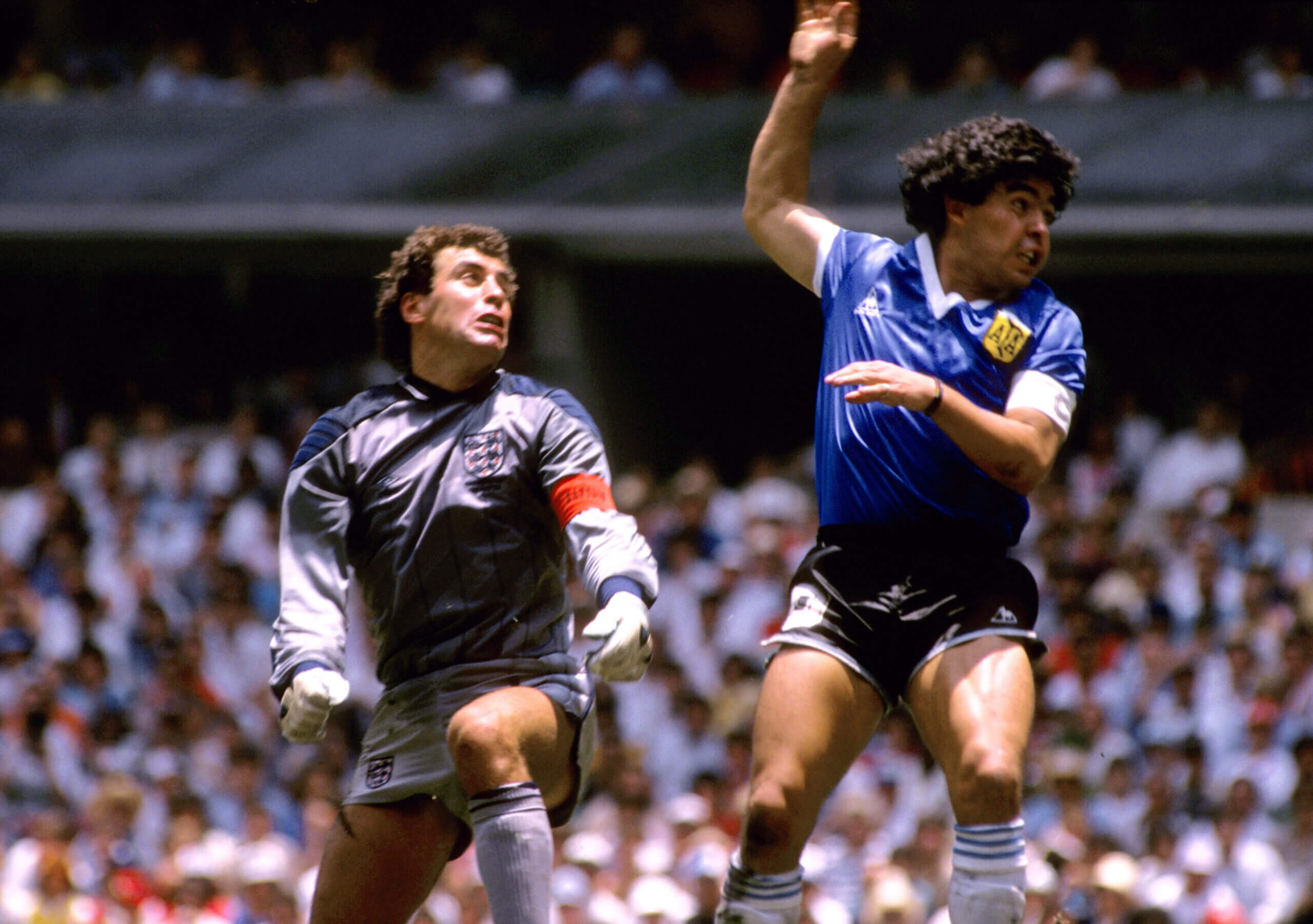

Mexico City, Azteca Stadium · Argentina vs England · 1986 FIFA World Cup
Table of Contents
- The World Stage: Argentina vs England in 1986
- What Actually Happened: Breaking Down Maradona’s Hand of God Goal
- The Goal of the Century: Maradona’s Redemption Four Minutes Later
- England’s Reaction and the Immediate Controversy
- Why Maradona’s Hand of God Goal Still Matters Decades Later
- Maradona’s Legacy and the Hand of God’s Place in Football History
On June 22, 1986, Diego Maradona punched a football into England’s net with his left hand, looked the referee in the eye, and kept running. Four minutes later, he scored the greatest goal ever recorded. One afternoon in Mexico City gave the world both the most controversial goal and the most brilliant goal in World Cup history, and football has never stopped talking about either.
The World Stage: Argentina vs England in 1986
The 1986 FIFA World Cup quarter-final between Argentina and England was never going to be a simple football match. Just four years earlier, the two nations had fought the Falklands War, a brutal 74-day armed conflict over a remote chain of islands in the South Atlantic. Soldiers from both countries had died. The wound was raw. By the time the two squads lined up at the Estadio Azteca in Mexico City, the match carried the weight of something far greater than sport.
Argentina entered the tournament as a team built almost entirely around one extraordinary man. Diego Armando Maradona, then 25 years old, was at the absolute peak of his powers. England, managed by Bobby Robson, featured a strong squad including Peter Shilton in goal and striker Gary Lineker. Both teams knew they were playing not just for a World Cup semi-final berth, but for national pride in the truest and most complicated sense.
What Actually Happened: Breaking Down Maradona’s Hand of God Goal
The first half ended goalless. In the 51st minute of the second half, Argentine midfielder Jorge Valdano played a through ball toward Maradona. England midfielder Steve Hodge, under pressure, attempted to hook the ball back to goalkeeper Peter Shilton but sent it looping awkwardly into the air above the penalty box. Maradona and Shilton both rushed toward it.
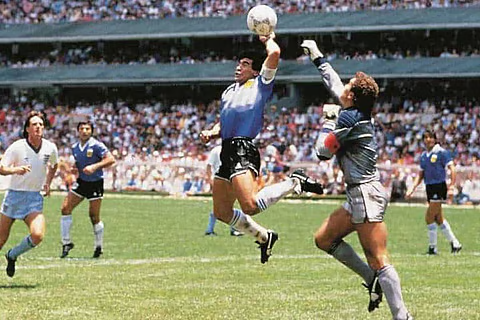
What followed took less than a second. Maradona, several inches shorter than Shilton, raised his left arm and punched the ball into the net. Shilton immediately began protesting to Tunisian referee Ali Bin Nasser. England’s players swarmed the official. Maradona, meanwhile, sprinted toward his teammates with his arms raised, deliberately avoiding eye contact with the referee, fully aware of exactly what he had done.
The referee, who had not seen the handball clearly and received no assistance from his linesman, allowed the goal to stand. Argentina led 1–0.
It was a little with the head of Maradona and a little with the hand of God.Diego Maradona, post-match press conference, June 22, 1986
That single sentence became one of the most quoted lines in sports history. It was defiant, poetic, and completely unapologetic. Maradona never expressed genuine remorse for the act itself, though he later admitted in his 2004 autobiography that the hand was deliberate, calling it a form of “symbolic revenge” against England for the Falklands War.
The Goal of the Century: Maradona’s Redemption Four Minutes Later
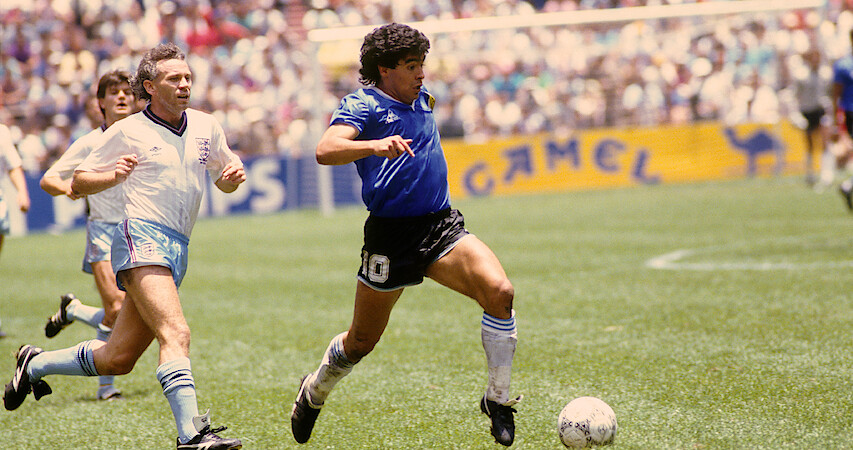
If the Hand of God goal revealed Maradona’s cunning, what came next revealed his genius. In the 55th minute, just four minutes after the controversial opener, Maradona received the ball inside his own half. What followed was a 10-second, 60-metre run in which he dribbled past five England outfield players and then goalkeeper Peter Shilton before sliding the ball into an empty net.
In 2002, a poll of 36,000 football fans conducted by FIFA voted this the Goal of the Century. It remains the standard against which all other individual goals are measured. The same man who had cheated his way to a goal had then produced perhaps the greatest piece of individual skill the game has ever seen, all in the same half, against the same opponents. The contrast was staggering and deliberate, as though Maradona himself understood the narrative he was writing in real time.
England’s Reaction and the Immediate Controversy
Peter Shilton was furious immediately after the match and remained so for decades. He has consistently and publicly refused to forgive Maradona for the handball, calling it a stain on the game. Bobby Robson called it “blatant cheating.” Gary Lineker, who scored England’s consolation goal in the 81st minute to make it 2–1, was characteristically measured but nonetheless clear that the result had been decided by an act of dishonesty.
English fans and media were incensed, and the controversy was amplified by television replays that made the handball unmistakably clear to millions of viewers worldwide who had seen what the referee had not. British tabloids were unsparing. In Argentina, however, the reaction was the polar opposite: Maradona was celebrated as a hero who had outwitted the English at everything, including at their own game.
Why Maradona’s Hand of God Goal Still Matters Decades Later
The Hand of God goal is not just controversial in isolation. It asks fundamental questions about sport, nationalism, and morality that have no clean answers. Was it cheating? Yes, without any doubt. Was it a product of its political context? Almost certainly. Does the brilliant goal that followed four minutes later somehow complicate the moral ledger? That is a question football supporters have debated for nearly 40 years.
The goal also changed football in a very practical sense. The introduction of Video Assistant Referee (VAR) technology, which now allows officials to review incidents including potential handballs in real time, is in no small part a legacy of moments like the Hand of God. The modern game has invested heavily in tools specifically designed to ensure that a referee can never again be fooled the way Ali Bin Nasser was in Mexico City.
Maradona’s Hand of God goal has also entered the broader cultural conversation far beyond football. It appears in films, literature, philosophy classes, and political speeches. It is used as a case study in discussions of fair play, the morality of competition, and the relationship between sport and war. Few moments in any sport carry quite so much meaning in such a short number of seconds.
Maradona’s Legacy and the Hand of God’s Place in Football History
Diego Maradona died on November 25, 2020. In the days that followed, tributes poured in from every corner of the football world, and not a single one failed to mention June 22, 1986. The Hand of God and the Goal of the Century are inseparable from his identity. They represent the full complexity of the man: the genius and the rogue, the brilliance and the dishonesty, all compressed into a single extraordinary quarter-final afternoon.
Argentina went on to win the 1986 World Cup, beating West Germany 3–2 in the final. Maradona was named the tournament’s best player and lifted the trophy in Mexico City. For Argentina, it remains one of the most important victories in the country’s history. For England, the defeat to a handball goal that stood stings as bitterly now as it ever did.
Maradona’s Hand of God goal will never be forgotten. It sits at the intersection of genius and gamesmanship, of national pride and personal cunning, of football and geopolitics. Whatever your view of the man, whatever side of the argument you stand on, one thing is beyond dispute: no single goal in World Cup history has generated more debate, more passion, and more conversation than the one Diego Maradona scored in the 51st minute at the Azteca on a hot June afternoon in 1986.
The hand of a man. The story of a game. The controversy of a lifetime.



No Comments