
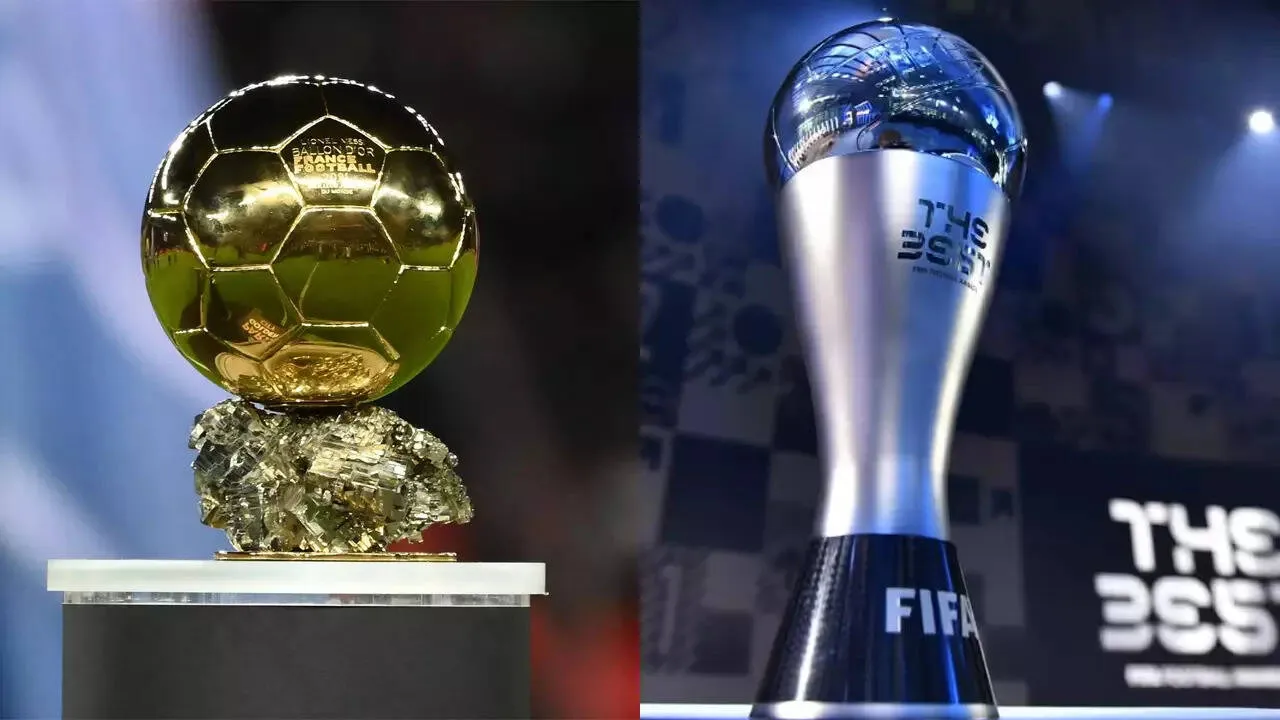

Few debates in modern football generate as much confusion as Ballon d’Or vs FIFA The Best. Casual fans often treat them as interchangeable. Analysts know they are not. Both honor the world’s best footballer, yet they differ in history, voting structure, and philosophical weight.
Table of Contents
- The Origins – How the Ballon d’Or and FIFA The Best Were Born
- Voting Systems Explained – Who Actually Decides the Winner?
- Ballon d’Or Voting Structure
- FIFA The Best Voting Structure
- Criteria and Philosophy – What Each Award Claims to Reward
- When Results Differ – Controversial Years and Split Decisions
- Prestige and Perception – Which Award Carries More Weight?
- The Role of Era Dominance – Messi, Ronaldo, and Award Inflation
- Statistical Impact – Measuring Legacy Through Individual Awards
- Are They Redundant or Complementary?
- Conclusion – Recognition, Legacy, and Football’s Need for Validation
The discussion intensified during the era dominated by Lionel Messi and Cristiano Ronaldo, when every award announcement carried implications for legacy and the GOAT debate. To understand which trophy carries greater prestige, one must first understand how they emerged, how they function, and what they truly represent.
The Origins – How the Ballon d’Or and FIFA The Best Were Born
The Ballon d’Or dates back to 1956. French magazine France Football created it to honor the best European player of the year. Over time, eligibility expanded. In 1995, non-European players at European clubs became eligible. By 2007, it transformed into a global award open to all professional footballers worldwide.
FIFA launched its own global player award in 1991 under the title FIFA World Player of the Year. In 2010, FIFA merged its award with the Ballon d’Or, creating the FIFA Ballon d’Or. That partnership lasted until 2015. In 2016, the organizations split, and FIFA introduced the The Best FIFA Football Awards as a separate entity.
Since then, football has operated with two major individual honors, each claiming to crown the world’s best.
Voting Systems Explained – Who Actually Decides the Winner?
The core difference in the Ballon d’Or vs FIFA The Best debate lies in who votes and how those votes are weighted.
Ballon d’Or Voting Structure
France Football organizes the Ballon d’Or voting process. As of recent editions, a select group of international journalists from top-ranked FIFA nations cast ballots. Each journalist ranks five players, assigning points on a structured scale. The cumulative total determines the winner.
This journalist-only model emphasizes analytical evaluation. It prioritizes informed observation, statistical output, and season-long impact.
FIFA The Best Voting Structure
FIFA’s award distributes voting power across four groups: national team captains, national team coaches, selected media representatives, and fans worldwide. Each group accounts for 25 percent of the final tally.
This broader democratic approach integrates public voice alongside professional opinion. While it increases inclusivity, critics argue it can amplify popularity over performance.
Voting structure alone often explains why winners occasionally differ between the two awards.
Criteria and Philosophy – What Each Award Claims to Reward
Both awards assess performance over roughly a one-year period, but they differ in evaluation emphasis.
The Ballon d’Or traditionally focuses on individual performance, team achievements, and a player’s class and fair play. In recent years, it has clarified criteria to include individual brilliance, decisive impact, and collective success.
FIFA The Best considers achievements during a defined period, typically aligned with the European football season rather than the calendar year. It also includes contributions to team success and overall influence on the game.
The distinction between calendar-year evaluation and seasonal assessment has contributed to different outcomes in certain years.
When Results Differ – Controversial Years and Split Decisions
There have been seasons where the awards aligned and others where they diverged. These splits fuel online debate and amplify scrutiny of voting systems.
For example, in 2018, Luka Modrić won both awards, signaling consensus. In other seasons, results have varied due to timing differences and voting composition.
Such divergence highlights a central truth: football performance is interpretive. Numbers tell part of the story, but narrative, leadership, and tournament impact often shape perception.
Prestige and Perception – Which Award Carries More Weight?
Historically, the Ballon d’Or carries deeper legacy. Its lineage stretches back nearly seven decades, linking modern stars with legends such as Johan Cruyff and Michel Platini.
FIFA The Best benefits from institutional authority. FIFA governs global football, organizes the World Cup, and commands commercial power. The award ceremony reflects that scale and spectacle.
Among players and historians, many still view the Ballon d’Or as the most prestigious football award due to its history and perceived voting purity. However, FIFA The Best carries immense contemporary influence and global visibility.
The Role of Era Dominance – Messi, Ronaldo, and Award Inflation
The sustained excellence of Messi and Ronaldo reshaped individual awards. Messi has won multiple Ballon d’Or titles, while Ronaldo has accumulated his own collection across both award formats. Their dominance created a near-monopoly that defined the 2010s.
This era intensified scrutiny. Every trophy became evidence in legacy arguments. Some critics argue that repeated victories diluted unpredictability. Others contend that dominance simply reflected unmatched consistency.
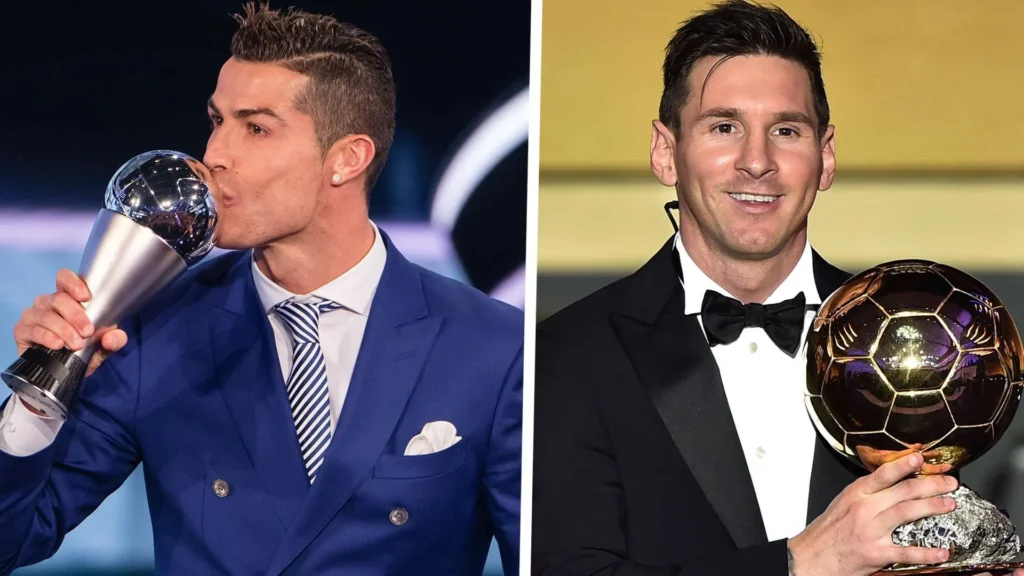
As new stars emerge, the perception of these awards may recalibrate.
Statistical Impact – Measuring Legacy Through Individual Awards
Individual awards influence how history remembers players. In GOAT discussions, Ballon d’Or totals frequently serve as shorthand for greatness. Media narratives often equate award count with historical rank.
Commercially, these trophies enhance marketability. Sponsors, clubs, and national federations leverage award wins to reinforce brand value. The symbolism extends beyond football into global recognition.
Yet awards complement statistics rather than replace them. Goals, assists, trophies, and decisive performances ultimately define legacy more comprehensively than a single annual ceremony.
Are They Redundant or Complementary?
The coexistence of two global awards raises a structural question. Does football benefit from multiple validations of excellence, or does it fragment authority?
Supporters argue that separate systems provide balance. Journalistic assessment offsets popularity voting. Institutional oversight contrasts with independent editorial judgment.
A unified award might simplify narrative, but diversity of evaluation also enriches debate. Football thrives on argument as much as achievement.
Conclusion – Recognition, Legacy, and Football’s Need for Validation
The Ballon d’Or vs FIFA The Best debate ultimately reflects football’s evolving identity. One trophy carries decades of historical gravitas. The other represents modern inclusivity and global reach.
Neither award defines greatness alone. Together, they shape how the sport measures excellence. In a game built on collective triumph, these individual honors capture moments when one player rises above all others.
Legacy in football will always depend on more than votes. But when the envelopes open and the names are called, history listens.



No Comments