
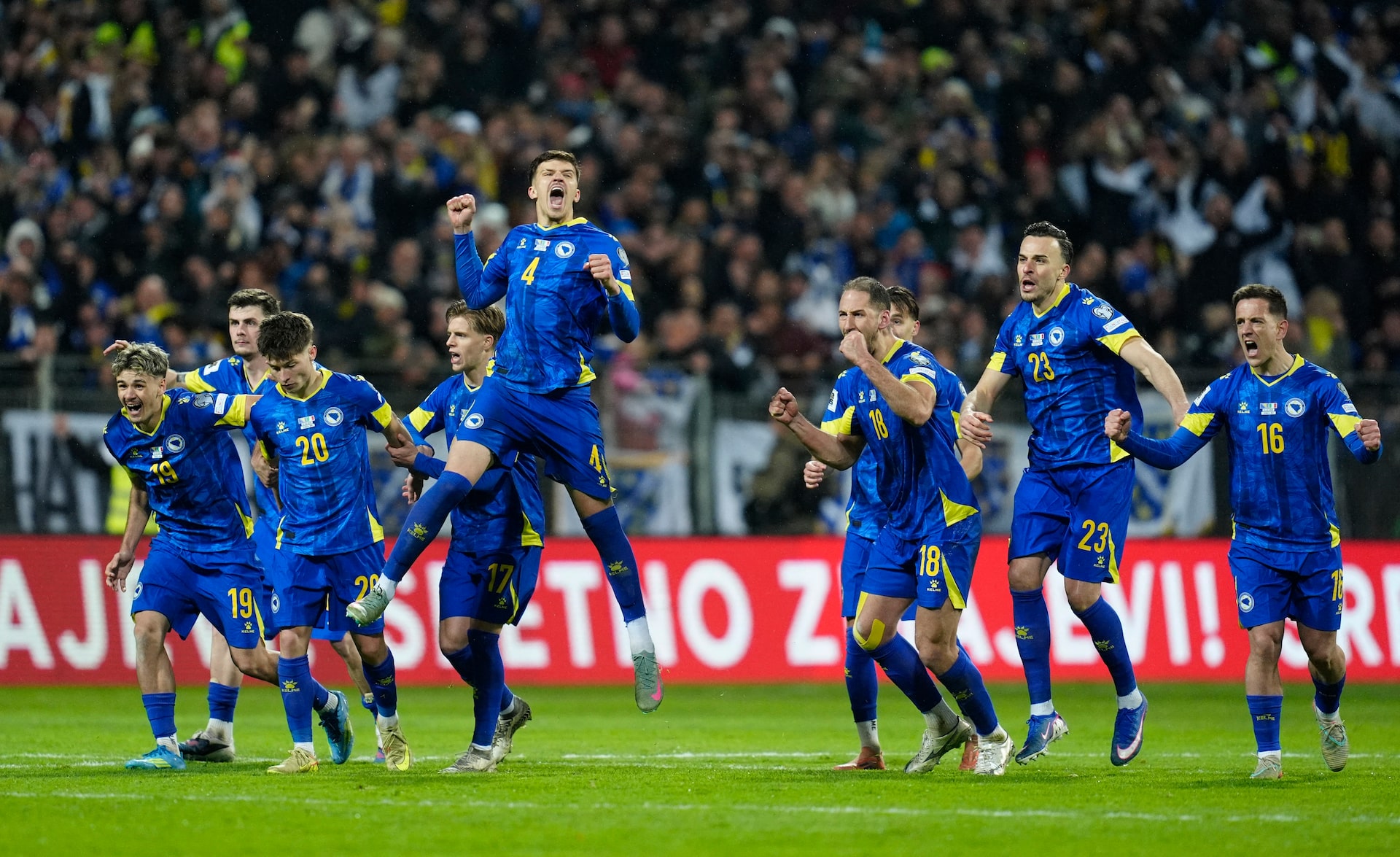

On the night of March 31, 2026, the unthinkable happened again. Italy — four-time World Cup winners, one of the most decorated nations in football history — lost to Bosnia and Herzegovina on penalties and confirmed their absence from the 2026 FIFA World Cup. It is the third consecutive tournament the Azzurri will miss, and with that, they have written themselves into the record books for all the wrong reasons.
Table of Contents
No former World Cup champion in history has ever missed three consecutive tournaments. Italy, who last played a World Cup in Brazil in 2014, have now secured that shameful distinction for themselves.
How It Happened — Again
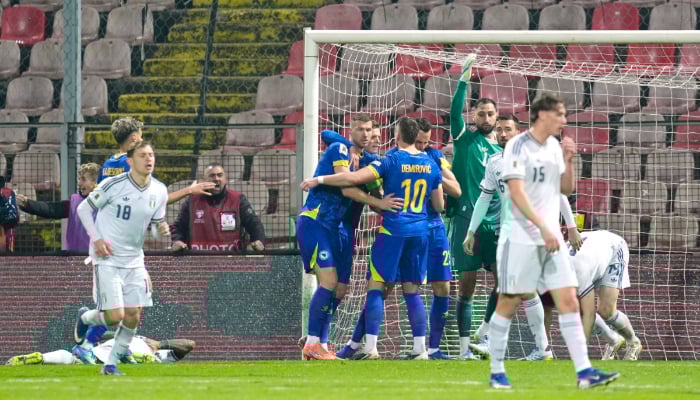
The night in Zenica had all the hallmarks of Italian footballing tragedy. Gennaro Gattuso’s side started brightly, with Moise Kean capitalising on a goalkeeper error in the 15th minute to put Italy ahead. Kean scored in his sixth consecutive Italy appearance — a feat achieved by only three players in the nation’s entire history before him.
Then Alessandro Bastoni was shown a red card just before half-time for a last-man foul, and the match turned completely. Bosnia substitute Haris Tabakovic levelled in the 79th minute, and despite 30 minutes of extra time, neither side could find a winner. In the shootout, Pio Esposito fired over the bar and Bryan Cristante hit the crossbar. Bosnia converted all four of their kicks. Italy were out.
The final score: Bosnia and Herzegovina 1–1 Italy (4–1 on penalties).
It was the third time in three qualifying campaigns that Italy have been eliminated at the playoff stage — by Sweden in 2018, North Macedonia in 2022, and now Bosnia in 2026. “I want to personally apologise since we didn’t make it,” Gattuso said afterwards. “Today talking about my future is not important.”
A Record That Should Never Exist
When Italy missed the 2018 World Cup, it was called a catastrophe. When they missed 2022, it was called a national crisis. Missing 2026 has no word strong enough for it.
Italy are now the first World Cup-winning nation in history to miss three consecutive tournaments. When the 2026 finals kick off in June, it will have been 12 years since Italy last played at a World Cup, and 20 years since they last won a knockout game — that 2006 final victory over France in Berlin.
The only other World Cup Italy ever failed to qualify for before this run was in 1958. That was a one-off shock. What is happening now is something different entirely — a structural collapse of a football nation.
Other Former Champions Who Have Stumbled
Italy’s situation is unprecedented in terms of consecutive absences, but other World Cup winners have had their own moments of humiliation on the qualification stage.
France — 1994 Three years before winning the World Cup on home soil, France failed to qualify for the 1994 tournament in the United States. They needed only to avoid defeat against Bulgaria in their final qualifier. With seconds remaining, David Ginola played a costly long ball that was intercepted, Bulgaria broke upfield, and Emil Kostadinov scored in the 90th minute to eliminate Les Bleus. It remains one of the most famous qualification collapses in history.
Uruguay — 1958 Winners of the first two World Cups in 1930 and 1950, Uruguay failed to qualify for the 1958 tournament in Sweden. At the time, it felt like an enormous shock. It remains the only qualification failure by the Uruguayan national team.
Spain — 1954 and 1958 Spain, who would go on to win consecutive European Championships and a World Cup between 2008 and 2012, have their own history of qualification failures. They failed to make it to both the 1954 and 1958 tournaments during an era when the likes of Alfredo Di Stéfano were at their peak — Di Stéfano became famous as the greatest footballer to never play in a World Cup, despite being arguably the best player of his generation.
England — 1974 and 1978 The 1966 World Cup winners have missed the tournament three times in their history — in 1974, 1978, and 1994. Missing back-to-back tournaments in the 1970s was a significant fall for a nation that had won the trophy just years earlier.
The Curse of the Champions
Italy’s broader World Cup decline fits into a wider pattern. Since France won the tournament in 1998, defending champions have made a habit of falling apart at the following edition.
France in 2002 arrived as both world and European champions, and crashed out of the group stage without scoring a single goal — still considered one of the worst performances by a defending champion in tournament history. Italy defended their 2006 title in 2010 by finishing bottom of their group, behind Paraguay, New Zealand and Slovakia. Spain arrived in Brazil in 2014 as three-time defending champions of major tournaments and were eliminated in the group stage after a 5–1 thrashing by the Netherlands. Germany, the 2014 winners, went out in the group stage in Russia in 2018, beaten by South Korea.
Of every team to win the World Cup since 1998, only France in 2022 made it back to the final in their title defence.
But what Italy are experiencing goes beyond that particular curse. No other champion has failed to even qualify for three straight tournaments.
What Went Wrong for Italy
The seeds of the current crisis were planted long before the 2018 qualifying disaster. Italy’s youth development system, once the envy of Europe, began to stagnate in the late 2000s. Club football in Serie A struggled commercially relative to the Premier League and La Liga, reducing the flow of talent into the top level. Tactical conservatism at national level stifled the creativity that had defined earlier generations.
The 2021 European Championship win — a superb tournament triumph under Roberto Mancini — flattered to deceive. Within months, Italy were eliminated by North Macedonia in a World Cup qualifier, exposing how thin the squad’s depth truly was. Mancini eventually resigned ahead of the 2026 qualifying campaign, and Gattuso was brought in to try to rescue a project already in crisis.
He could not save them.
What Happens Next
Gattuso faces an uncertain future after the defeat. Italy’s football federation will need to make significant decisions about the direction of the national team, with the 2030 World Cup qualification cycle starting within two years.
There is, at least, some genuine talent in the Italian system. Moise Kean is 26 and scored in six consecutive appearances for the national team during this campaign. Sandro Tonali has re-established himself at Newcastle United as one of the best midfielders in the Premier League. Nicolo Barella remains world class.
But a generation has now grown up in Italy with no memory of watching the Azzurri at a World Cup. A child who was born when Italy last played at the tournament in 2014 will be 12 years old when the 2026 finals take place in North America.
For a country that has won the trophy four times and has football woven into its national identity at every level, that fact alone should be the loudest alarm bell of all.







No Comments