
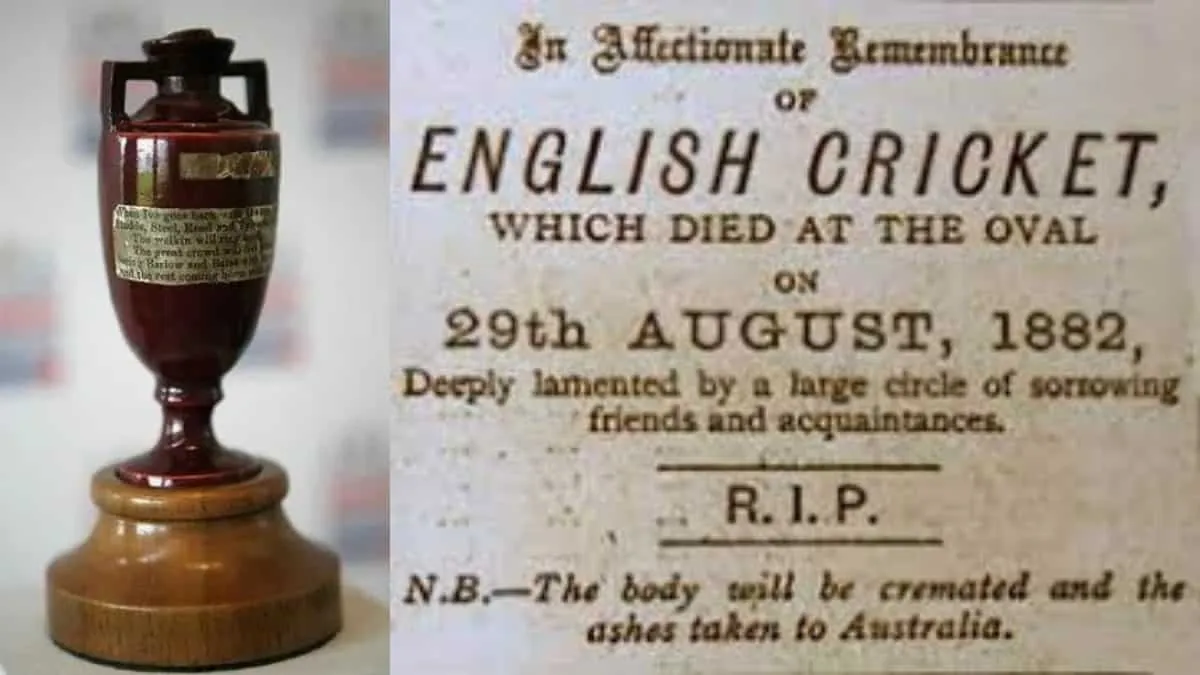

Few rivalries in sport carry the weight of time quite like The Ashes history. It began not with a trophy ceremony, but with satire. In 1882, after Australia defeated England at The Oval, a British newspaper published a mock obituary declaring that English cricket had died and “the body will be cremated and the ashes taken to Australia.”
Table of Contents
- Origins of the Ashes – From Satire to Sporting Institution
- Early Battles – Establishing Dominance in the Pre-War Era
- The Bradman Era – Statistical Supremacy and Psychological Impact
- Post-War Shifts – Cycles of Control and Iconic Series
- Modern Ashes Classics – 2005 and the Revival of Global Interest
- The Statistical Rivalry – Numbers Behind 140 Years
- Psychology and National Identity – Why the Ashes Means More
- Tactical Evolution – How the Rivalry Mirrors Cricket’s Development
- The Future of the Ashes – Tradition in a T20 World
- Conclusion – A Rivalry That Outlives Generations
That line ignited what would become the most storied bilateral contest in cricket. More than 140 years later, England vs Australia remains a contest layered with pride, memory, and national identity. The Ashes is not merely a Test series. It is a narrative passed from generation to generation.
Origins of the Ashes – From Satire to Sporting Institution
The famous obituary appeared in The Sporting Times following Australia’s first Test victory on English soil in 1882. Later that winter, England captain Ivo Bligh traveled to Australia determined to “recover the Ashes.” During the 1882–83 tour, Bligh received a small urn from Melbourne socialites, said to contain the ashes of a burnt cricket bail.
The urn itself now resides at Lord’s under the care of the Marylebone Cricket Club. Though the original urn is symbolic and rarely travels, its mythology defines the contest. Every Ashes series since has been played under that shadow of legacy.
What began as humor became an institution. The Ashes history grew into cricket’s benchmark rivalry.
Early Battles – Establishing Dominance in the Pre-War Era
In the early decades, England often held the upper hand, leveraging experience and structured domestic cricket systems. However, Australia’s rise in the early 20th century reshaped competitive balance.
Tours were long, travel was arduous, and uncovered pitches added unpredictability. Yet even then, tactical patterns began forming. Fast bowling duels, attritional batting, and psychological edge-play defined encounters.
By the time the First World War interrupted international cricket, the rivalry had already embedded itself into sporting culture on both sides of the world.
The Bradman Era – Statistical Supremacy and Psychological Impact
No discussion of The Ashes history is complete without Don Bradman. Bradman’s dominance during the 1930s transformed the rivalry into a contest of containment.
His record in Ashes cricket remains staggering. Bradman averaged over 89 in Ashes Tests and scored multiple double centuries against England. His overall Test average of 99.94 remains the highest in history.
England’s infamous Bodyline strategy during the 1932–33 series sought to counter Bradman through short-pitched bowling aimed at the body with leg-side fields. While tactically controversial, it demonstrated how far England would go to reclaim competitive parity.
Bradman elevated the rivalry from competitive to psychological warfare.
Post-War Shifts – Cycles of Control and Iconic Series
After World War II, the rivalry entered cycles of dominance. Australia’s post-war sides, including the 1948 “Invincibles,” maintained control. England responded in later decades with resilient teams built around disciplined bowling attacks.
The 1970s and 1980s saw fluctuating supremacy, often defined by charismatic captains and fast-bowling intensity. The rivalry evolved with changing cricket economics, broadcast expansion, and professional fitness standards.
Yet regardless of era, Ashes contests retained their emotional volatility.
Modern Ashes Classics – 2005 and the Revival of Global Interest
Few modern series captured global imagination like The Ashes 2005. England’s dramatic 2–1 victory ended Australia’s extended dominance and revitalized public interest in Test cricket.
The series featured narrow finishes, individual heroics, and sustained tension across five Tests. It demonstrated that even in a rapidly commercializing cricket landscape, the Ashes could still command universal attention.

Subsequent series have continued to oscillate in competitiveness, often reflecting home advantage trends. Australia has historically dominated at home, while England has frequently leveraged English conditions to their benefit.
The Statistical Rivalry – Numbers Behind 140 Years
As of recent completed series, Australia holds a slight overall edge in total Ashes series wins. Across more than 70 series played since 1882–83, the balance has shifted multiple times.
Home advantage plays a significant role. English swing conditions contrast sharply with Australian pace-friendly pitches. This environmental divergence shapes squad selection and strategic planning.
Milestones further enrich Ashes statistics. Multiple players have crossed 5,000 Ashes runs or claimed 100 Ashes wickets, embedding their names permanently in the rivalry’s record books.
Numbers alone, however, do not capture the emotional currency of these contests.
Psychology and National Identity – Why the Ashes Means More
England vs Australia extends beyond sport. The rivalry reflects colonial history, cultural competition, and mutual respect tinged with defiance.
Players often describe Ashes series as uniquely pressurized. Media scrutiny intensifies. Public expectation multiplies. Tactical sledging and verbal sparring become strategic tools.
In this environment, composure defines champions. Careers can be defined or derailed by Ashes performance. That psychological weight distinguishes the series from ordinary bilateral contests.
Tactical Evolution – How the Rivalry Mirrors Cricket’s Development
The Ashes mirrors cricket’s broader evolution. Early contests unfolded on uncovered pitches with minimal protective gear. Modern series feature Decision Review System technology, high-performance analytics, and structured rotation policies.
Bowling philosophies have oscillated between pace dominance and spin strategy depending on conditions. Batting approaches have shifted from attritional accumulation to more assertive run-scoring, particularly in recent English approaches emphasizing tempo.
Each generation adapts, but the rivalry’s core remains unchanged: win the Ashes at all costs.
The Future of the Ashes – Tradition in a T20 World
In an era increasingly influenced by franchise cricket and T20 leagues, questions arise about the future of five-Test series. Scheduling congestion and commercial pressures challenge traditional formats.
Yet the Ashes continues to command full houses and global broadcast audiences. Its narrative continuity gives it resilience. Even as cricket modernizes, this rivalry anchors the sport’s historical identity.

If anything, the contrast between fast-paced formats and traditional Ashes contests enhances appreciation for Test cricket’s endurance.
Conclusion – A Rivalry That Outlives Generations
The Ashes history is not a simple ledger of wins and losses. It is a living chronicle of cricket’s evolution, shaped by iconic players, tactical innovation, and national pride.
From a satirical obituary in 1882 to packed stadiums in the modern era, England vs Australia remains cricket’s defining contest. The urn may be small, but its symbolism looms large.
In a sport constantly adapting to change, the Ashes endures as a reminder that legacy, rivalry, and memory often outlast statistics. As long as Test cricket survives, this 140-year rivalry will continue to define its highest standard.







No Comments