
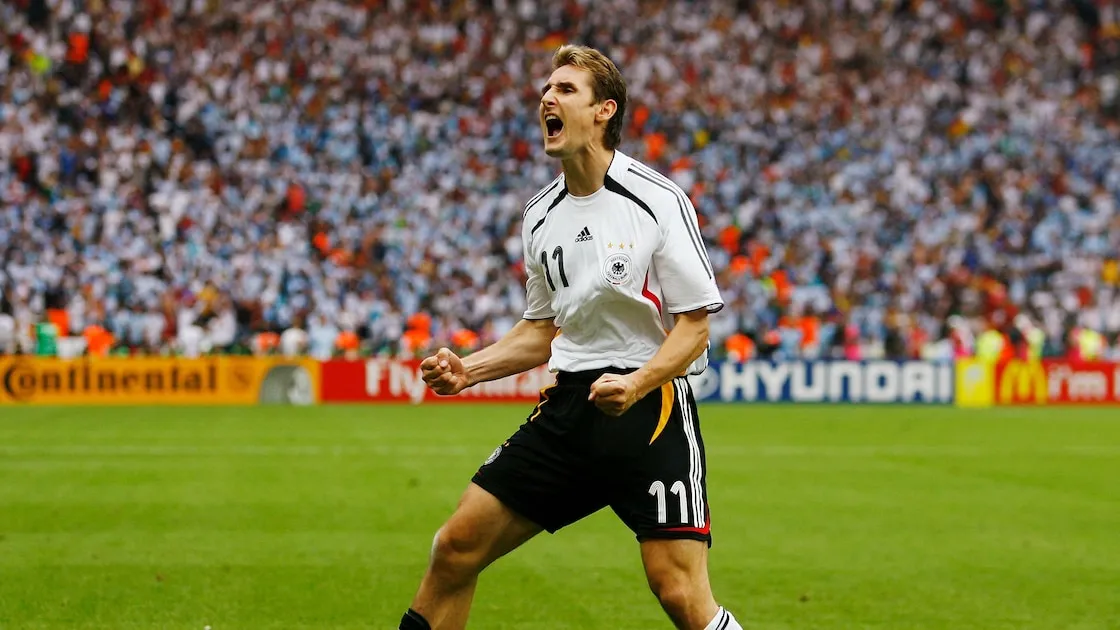

Across more than nine decades of football, no stage has produced pressure like the FIFA World Cup. Nations stop. Streets empty. The weight of an entire country rests on twenty-two players and a single ball. It is in that environment, the most demanding in world sport, that one man rose above every other to claim a record that may never be broken.
Table of Contents
- The Record That Stands Alone
- Tournament by Tournament: How Klose Built the Record
- The Goal That Made History
- What Made Klose Impossible to Stop at World Cups
- The Other Names in the Conversation
- Can Anyone Challenge the FIFA World Cup All-Time Top Scorer Record?
- A Legacy Written Across the Grandest Stage in Football
The FIFA World Cup all-time top scorer is Miroslav Klose of Germany, whose 16 goals across four tournaments represent a standard of sustained excellence that the history of the game has never seen before and is unlikely to see again.
The Record That Stands Alone
Sixteen goals. Four tournaments. Fourteen years of World Cup football. When Klose retired from international football in 2014, he left behind a scoring record that surpassed every great who had come before him. His 16 goals moved him one clear of Brazil’s Ronaldo, who had held the record at 15 across his own remarkable World Cup career. Klose’s record is not simply the product of longevity, though.
It is the result of delivering at the highest level when the stakes demanded it most, a pattern that defined every one of his four appearances on the world’s biggest stage.
Tournament by Tournament: How Klose Built the Record
Klose’s World Cup story began in 2002 in South Korea and Japan, where a relatively unknown 24-year-old striker announced himself to the global game with five goals, including a hat-trick of headers against Saudi Arabia. His aerial ability and relentless movement made him impossible to manage for opposition defenses, and Germany’s run to the final was built significantly on his contributions. He did not win the tournament, but he introduced himself to the world in the most emphatic way possible.
The 2006 World Cup in Germany brought five more goals on home soil, earning him the Golden Boot as the tournament’s top scorer. Playing in front of his own nation, Klose elevated his game further. His movement between the lines, his ability to time runs against high defensive lines, and his composure in front of goal were all on full display. Germany finished third that year, but Klose had confirmed himself as the most dangerous striker in world football.
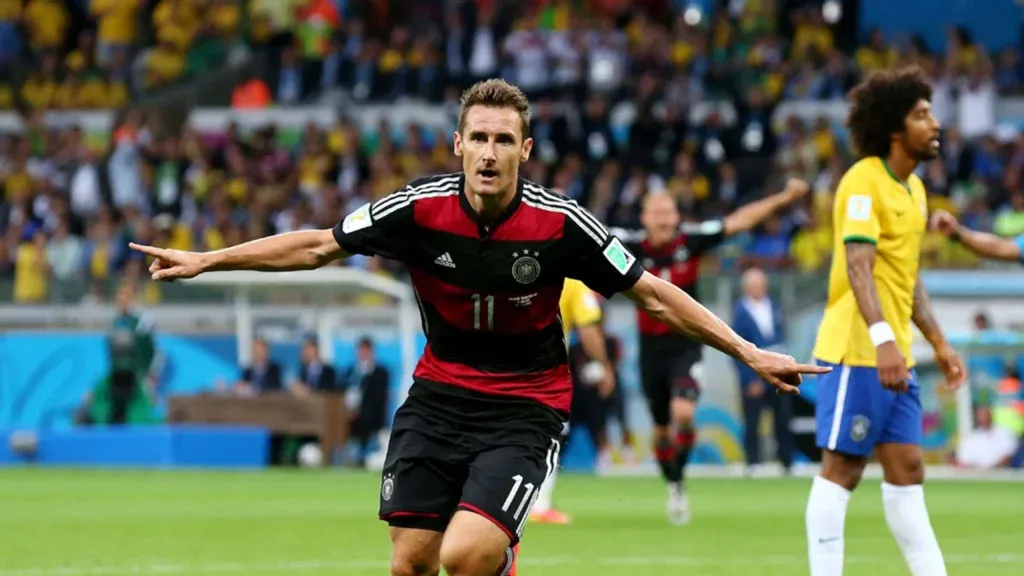
Four goals in 2010 in South Africa took his career total to 14, level with West Germany’s Gerd Müller, then the all-time record holder. By this point, Klose was 32 and questions about his pace and sharpness were being raised. He answered them not with words but with performances, proving that the instincts of a great goalscorer do not diminish with age. Four more goals in 2014 completed the journey, with his 16th arriving in the most dramatic circumstances imaginable.
The Goal That Made History
On the night of July 8, 2014, in Belo Horizonte, Brazil, Klose wrote the final chapter of his record in a match that football will never forget. Germany’s semifinal against the host nation became one of the most extraordinary evenings in World Cup history. With Germany leading 1-0 through Thomas Müller, Klose latched onto a rebound in the 23rd minute and slotted the ball into the net to make it 2-0. That goal, his 16th World Cup strike, surpassed Ronaldo’s long-standing record and placed Klose alone at the summit of the all-time charts.
Germany went on to win 7-1 that night. But for Klose, the number that mattered was one: the single goal that separated him from every striker who had ever played the game.
What Made Klose Impossible to Stop at World Cups
Statistics only tell part of the story. What made Klose so uniquely dangerous at World Cups was the combination of technical intelligence and psychological composure that surfaced when every match truly mattered. His movement off the ball was studied and precise, creating space that defenders consistently failed to account for. His heading ability, honed from years of technical work, gave him a dimension that made him a threat from virtually every attacking position on the pitch.
Beyond the physical and technical qualities, Klose possessed the temperament of a genuine big-game player. There is a documented pattern across his four World Cup campaigns of goals arriving at crucial moments, in knockout rounds, in tight games, and against opponents who had specifically prepared to stop him. He never seemed burdened by the weight of expectation. He seemed, instead, to use it as clarity, knowing that the biggest stages were exactly where his best football would appear.
The Other Names in the Conversation
To appreciate the full scale of Klose’s achievement, it helps to understand the company he keeps at the top of the all-time scoring charts. Ronaldo of Brazil, one of the most devastating forwards the sport has ever produced, finished his World Cup career with 15 goals across four tournaments spanning 1994 to 2006. Before him, West Germany’s Gerd Müller claimed 14 goals across the 1970 and 1974 editions, a tally built across just two tournaments that speaks to a frequency of scoring almost beyond comprehension.
France’s Just Fontaine scored 13 goals in a single World Cup in 1958, a record for goals in one edition of the tournament that remains untouched. Each of these men was a generational talent. That Klose outlasted and outscored all of them is the measure of his greatness.
Can Anyone Challenge the FIFA World Cup All-Time Top Scorer Record?
Since Klose set the record in 2014, the question of whether any active player could mount a challenge has circled the sport. Cristiano Ronaldo of Portugal has eight World Cup goals across five tournaments. Lionel Messi of Argentina finished his career with 13 World Cup goals after leading Argentina to the 2022 title in Qatar, a magnificent total but still three behind Klose’s mark.
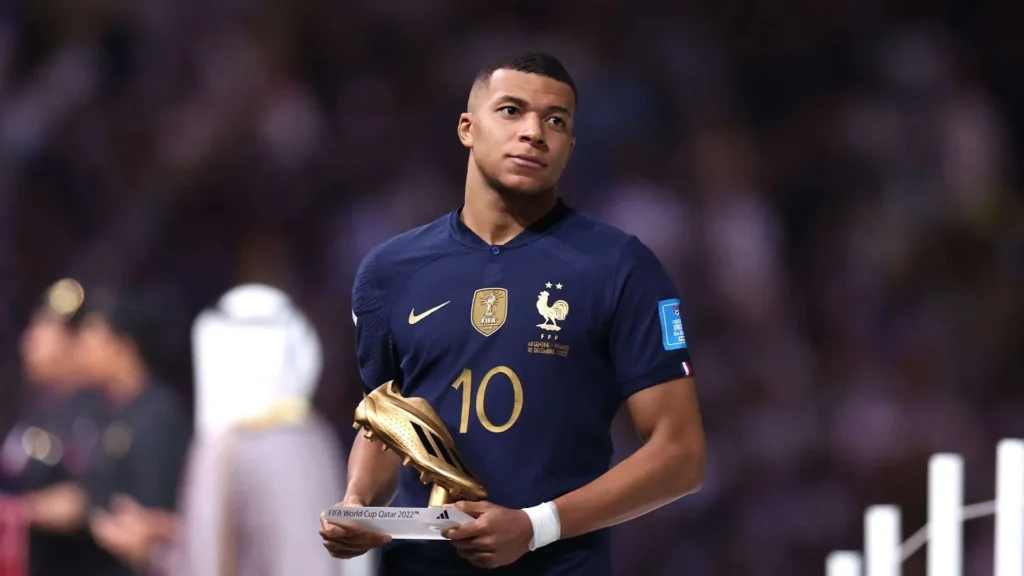
Kylian Mbappé, France’s generational forward, has 12 World Cup goals before turning 26, making him the most credible threat to the record in the coming years. Whether he can reach 16 across future tournaments remains one of football’s most compelling open questions.
A Legacy Written Across the Grandest Stage in Football
Miroslav Klose’s 16 World Cup goals are more than a record. They are a statement about what sustained excellence under pressure looks like across the span of a career. From a 24-year-old arriving on the world stage in 2002 to a 36-year-old writing history in Brazil in 2014, he delivered in the moments that defined tournaments and defined nations.
Whether the record stands for another decade or another generation, the name at the top of the FIFA World Cup all-time top scorer list belongs to a player whose performances across four tournaments will be studied, celebrated, and marvelled at for as long as football is played.




No Comments