


The Golden Boot is the purest measure of a striker’s worth. No assists, no creative contributions, no defensive work rate — just goals, the only currency that ultimately decides football matches and defines careers. Across domestic leagues, World Cup tournaments, and continental competitions, the race to finish as the leading scorer each season has produced some of the most memorable individual achievements in the sport’s history. The players who have claimed these prizes most consistently have not simply been prolific. They have been relentless, redefining what is possible in front of goal across generation after generation.
Table of Contents
- What the Golden Boot Award Means in Football
- The European Golden Shoe and Its Most Dominant Winners
- Golden Boot Winners at the FIFA World Cup
- Premier League Golden Boot Winners and the Race for England’s Top Scorer
- How Ronaldo and Messi Redefined What Golden Boot Winners Look Like
- The Forwards Who Won the Golden Boot and Changed Their Clubs Forever
- What Separates Golden Boot Winners from Every Other Striker
- The Next Generation of Golden Boot Winners to Watch
- What the Greatest Golden Boot Winners Leave Behind
This is the full story of football’s greatest Golden Boot winners, the records they set, the eras they defined, and what separates them from every other striker the game has produced.
What the Golden Boot Award Means in Football
The Golden Boot exists in several forms, each carrying its own prestige and meaning. The European Golden Shoe, awarded annually to the top scorer across all of Europe’s top domestic leagues, represents the broadest measure of individual scoring excellence at club level. The FIFA World Cup Golden Boot identifies the tournament’s leading scorer every four years, placing a player’s performance on the sport’s largest global stage. The Premier League Golden Boot, presented since the competition’s founding in 1992, tracks the most prolific scorer in what many consider the world’s most competitive domestic league.

Each award measures something slightly different, but all three share a common significance — they mark the player who, above everyone else in their competition, found ways to score when it mattered and did so with a consistency that no rival could match.
The European Golden Shoe and Its Most Dominant Winners
The European Golden Shoe has been awarded since the 1967-68 season, originally presented to the highest scorer across all European leagues regardless of competition strength. Since 1997, a weighted points system rewards goals scored in stronger leagues more heavily, ensuring the award reflects quality of opposition rather than volume of weaker fixtures alone.
Lionel Messi holds the all-time record with six European Golden Shoes, won in 2009-10, 2011-12, 2012-13, 2016-17, 2017-18, and 2018-19, all for Barcelona. His peak season came in 2011-12 when he scored 50 La Liga goals, a figure that remains the single-season record for the award. Cristiano Ronaldo follows with four wins across Manchester United and Real Madrid. No other player in the history of the award has won it more than twice, which places the scale of the Messi-Ronaldo duopoly into sharp statistical relief. Kylian Mbappé claimed his first European Golden Shoe in 2024-25 with 31 goals for Real Madrid, becoming the first player since Ronaldo to win the award from the Santiago Bernabéu.
Golden Boot Winners at the FIFA World Cup
The World Cup Golden Boot carries a weight that no domestic award can fully replicate because it is contested once every four years, on the sport’s biggest stage, against the best defences every nation can produce. Eusébio set the benchmark for the modern era at the 1966 World Cup in England, scoring nine goals in six games for Portugal in one of the most individually dominant tournament performances the competition has ever witnessed.
Just Fontaine of France holds the all-time single-tournament record with 13 goals at the 1958 World Cup in Sweden, a tally so far beyond any other player in a single edition that it has stood unreached for nearly seven decades. Kylian Mbappé became the most recent World Cup Golden Boot winner in Qatar 2022, scoring eight goals including a hat-trick in the final against Argentina, finishing one goal ahead of Lionel Messi’s seven. Remarkably, no player has ever won the FIFA World Cup Golden Boot more than once since the official award was introduced in 1982, reflecting the fierce unpredictability of tournament football.
Premier League Golden Boot Winners and the Race for England’s Top Scorer
The Premier League Golden Boot has been contested since the inaugural 1992-93 season, when Teddy Sheringham of Tottenham Hotspur claimed the first award with 22 goals. The standard has risen dramatically in the three decades since, with Erling Haaland setting the current single-season record of 36 goals for Manchester City in 2022-23, surpassing the 38-game era record of 32 set by Mohamed Salah in 2017-18.
Thierry Henry and Mohamed Salah share the record for most Premier League Golden Boots won by a single player, with four each. Henry claimed his four in five seasons between 2001-02 and 2005-06, including a 30-goal campaign during Arsenal’s Invincibles season of 2003-04. Salah matched that total in 2024-25, scoring 29 goals as Liverpool claimed the Premier League title, becoming the first player in the competition’s history to finish a season as the leading scorer and provider of assists while also winning the Player of the Season award.
How Ronaldo and Messi Redefined What Golden Boot Winners Look Like
Before Lionel Messi and Cristiano Ronaldo dominated the European Golden Shoe landscape, no player in the award’s history had won it more than twice. Between 2008 and 2019, the two players claimed ten of twelve editions between them, establishing a standard of domestic scoring consistency that had no historical precedent and has not been approached since their peak years ended.
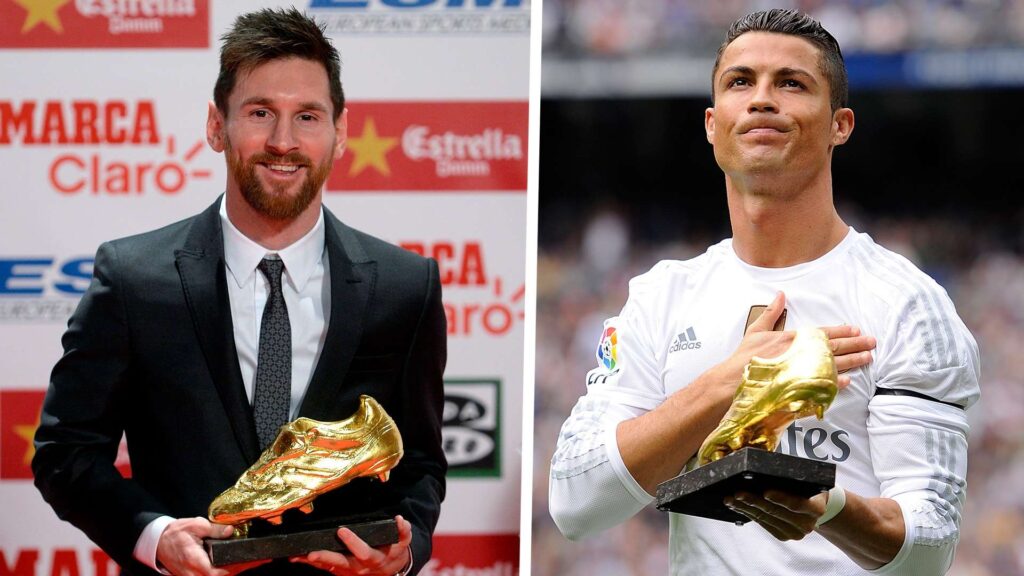
Messi’s 50-goal La Liga season in 2011-12 and Ronaldo’s 48-goal return in 2014-15 both sit among the highest single-season league scoring tallies in European football history. Their rivalry across those years pushed each player to output levels that, in any previous era, would have been considered statistically implausible. The generation of Golden Boot winners that followed them, from Robert Lewandowski’s consecutive wins in 2020-21 and 2021-22 to Haaland and Mbappé’s current pursuit, has been shaped entirely by the standards Messi and Ronaldo established.
The Forwards Who Won the Golden Boot and Changed Their Clubs Forever
Some of the most significant Golden Boot seasons in football history are defined not just by the goal tallies but by what those goals delivered collectively. Luis Suárez’s Premier League Golden Boot in 2013-14 with 31 goals across just 33 games came during one of the most captivating title races the competition has produced, as Liverpool came within two points of their first title since 1990. His individual output in that season remains one of the most extraordinary scoring campaigns any European league has witnessed.
Jamie Vardy’s Premier League Golden Boot in 2019-20, scoring 23 goals for Leicester City, built on the foundation of his unforgettable contribution to their title-winning season of 2015-16 and confirmed him as one of the most consistently clinical strikers the competition has produced. Ruud van Nistelrooy’s 25-goal Premier League campaign for Manchester United in 2002-03 fell one goal short of Henry’s tally that season but demonstrated the relentless penalty-box efficiency that made him the most feared finisher in European football during those years.
What Separates Golden Boot Winners from Every Other Striker
The forwards who accumulate Golden Boots across multiple seasons share qualities that go well beyond natural finishing ability. Movement off the ball, the intelligence to find positions that defenders cannot cover without exposing space elsewhere, is the foundational skill that every elite scorer develops to a level no coaching can fully manufacture. It is observed, absorbed, and refined across thousands of hours of match play until it becomes instinctive.
Composure under pressure is the other separating quality. Scoring 20 goals in a season is achievable for most top-division strikers in ideal conditions. Scoring 30 or more requires performing at maximum output across an entire campaign, through poor form, injury disruption, defensive focus from opponents, and the psychological weight that comes with leading the scoring charts. The strikers who become Golden Boot winners repeatedly are those for whom that pressure sharpens rather than diminishes their output.
The Next Generation of Golden Boot Winners to Watch
Erling Haaland’s 36-goal Premier League debut season in 2022-23 established him as the most statistically dominant striker to enter the English game in its modern era. His goals-per-game ratio of 1.03 in that campaign has no equivalent in Premier League history, and his back-to-back Golden Boots confirmed that the 2022-23 season was not an aberration but a statement of long-term intent.

Kylian Mbappé’s 2024-25 European Golden Shoe at Real Madrid confirmed that his transition from Ligue 1 dominance to La Liga had produced no reduction in output. He now holds the European Golden Shoe, the World Cup Golden Boot, and the Champions League Golden Boot — a combination no player in football history has achieved before. The race between these two players across the next five years will define the Golden Boot conversation for an entire era of the sport.
What the Greatest Golden Boot Winners Leave Behind
Golden Boot winners are the players football remembers most vividly because their contribution is the most directly countable. Goals accumulate into a record that outlasts careers, transfers, and tactical evolutions, a numerical legacy that tells the story of what a player was capable of more clearly than any description could. From Eusébio’s nine goals in 1966 through Messi’s six European Golden Shoes across a decade of Barcelona brilliance to Haaland’s record-shattering arrival in the Premier League, the through-line is the same: a refusal to stop scoring and an ability to do so consistently at the highest level of the sport.
The greatest Golden Boot winners in football history did not simply outscore their peers. They made goal-scoring look inevitable, and in doing so, they set standards that every forward who has followed them has been measured against ever since.





No Comments