
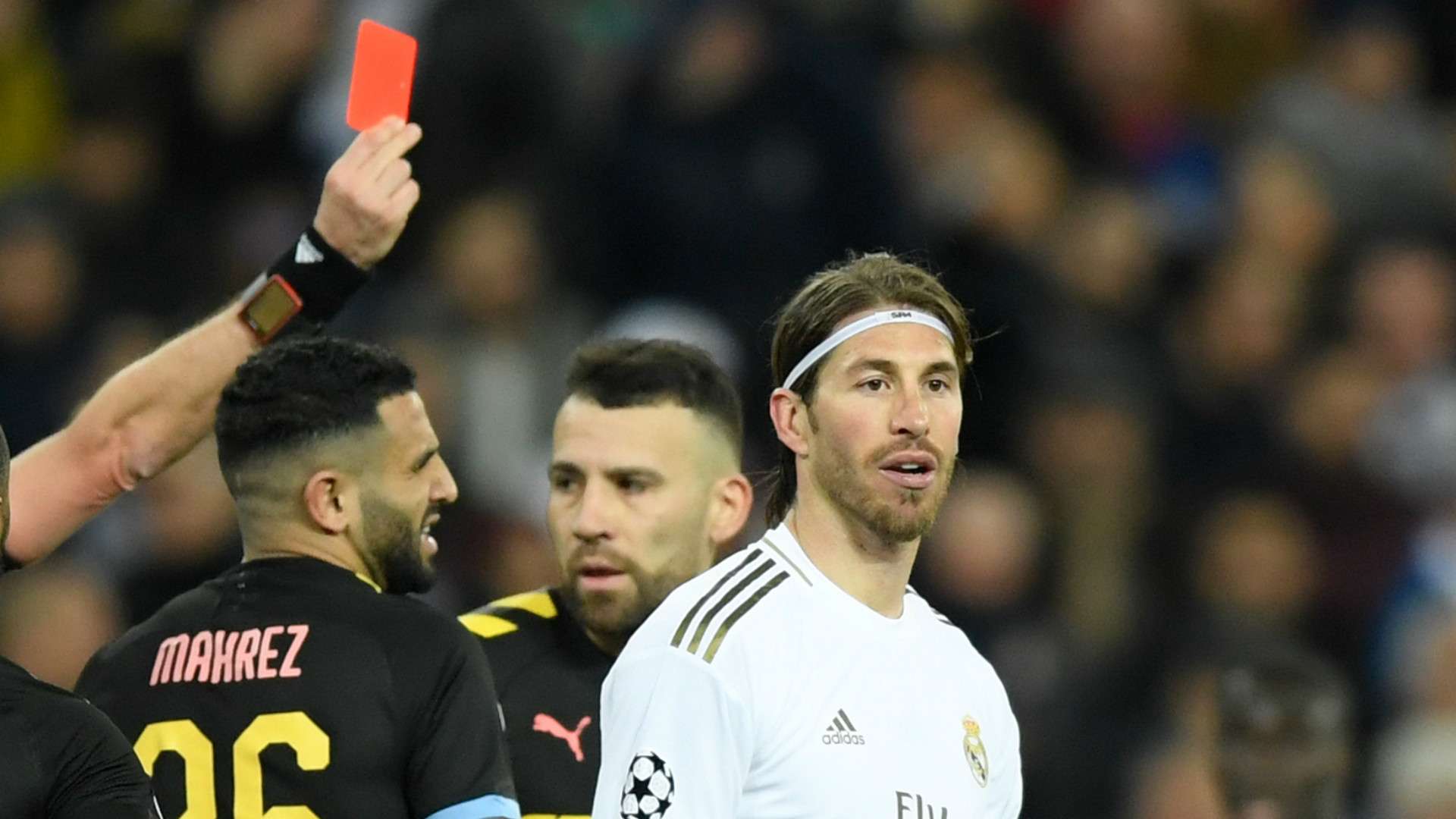

No defender in football history has occupied the space between greatness and infamy quite like Sergio Ramos. He won five La Liga titles, four Champions League trophies, the 2010 World Cup, and two European Championships. He captained Real Madrid through the most successful period the club has seen in a generation.
Table of Contents
- Sergio Ramos Red Card Record: The Numbers That Define a Career
- The Tactical Fouls That Made Ramos Both Brilliant and Brutal
- Most Infamous Red Cards in Sergio Ramos’s Career
- How Sergio Ramos’s Red Card Record Affected Real Madrid
- The Greatest Defender of His Generation Despite the Controversy
- How Rivals, Managers, and Referees Viewed the Sergio Ramos Red Card Record
- The Legacy of Sergio Ramos Beyond the Red Cards
- What Sergio Ramos Redefined About the Modern Defender
He also accumulated 30 red cards across his career, holds the all-time La Liga record for dismissals, and became the most sent-off player in the history of Europe’s top five leagues combined. The Sergio Ramos red card record did not exist despite his greatness. In many ways, it existed because of it.
Sergio Ramos Red Card Record: The Numbers That Define a Career
Ramos accumulated 20 red cards in La Liga, the highest total any player has ever recorded in Spain’s top flight. He received 26 dismissals across all competitions for Real Madrid alone, a club record more than twice ahead of any other player in the club’s history.
His 191 total bookings across La Liga, covering 171 yellows and 20 reds, represent the highest combined disciplinary total the competition has ever recorded. In the Champions League, his four red cards make him joint-most dismissed player in the competition’s history alongside Edgar Davids and Zlatan Ibrahimovic. Most remarkably, he received not a single red card across 180 appearances for Spain. That anomaly alone tells you how precisely he understood the line between aggression and consequence.
The Tactical Fouls That Made Ramos Both Brilliant and Brutal
Ramos was not an impulsive, hot-headed defender who lost control under pressure. He was a calculating, tactically intelligent player who used professional fouling as consciously as any other technique in his defensive arsenal.

In 2019, he publicly admitted he had deliberately earned a booking against Ajax in the Champions League Round of 16 to wipe his yellow card tally ahead of the quarterfinals. The admission earned him a UEFA disciplinary investigation and a two-match ban. It was controversial. It was also entirely consistent with how he had operated throughout his entire career.
Most Infamous Red Cards in Sergio Ramos’s Career
His red card history against Barcelona stands in a category of its own. He was sent off five times against the Catalan club, more than any other player in the history of the fixture, across the most hostile period of the Clasico rivalry between 2009 and 2012.
His sending off against Girona in February 2019 made him the most dismissed player in the history of all five major European leagues, overtaking the previous record of 19 held by French midfielder Cyril Rool. His red card against Manchester City in February 2020, for a last-man challenge on Gabriel Jesus, cost his side at a critical juncture of the Champions League and ended his Real Madrid career on a difficult disciplinary note.
How Sergio Ramos’s Red Card Record Affected Real Madrid
Across his first 22 red cards for Real Madrid, the subsequent suspensions covered 24 matches. Madrid won 18 of those games, drew three, and lost three. The club simply did not miss him badly, a reflection both of their squad depth and of Ramos’s legal team successfully challenging multiple dismissals through the appeal process.
The occasion where his absence proved most damaging came in the 2019 Champions League second leg against Ajax. His self-engineered suspension, publicly acknowledged, coincided with a 4-1 defeat that crashed Madrid out of the competition. The optics of a captain engineering his own suspension and watching his team humiliated from the stands were as damaging as any red card he had received in the preceding fourteen years.
The Greatest Defender of His Generation Despite the Controversy
The case for Ramos as the finest centre-back of his generation requires no qualification around his disciplinary record. His 22 major honours for Real Madrid, combined with the 2010 World Cup and two European Championships for Spain, place him in an elite category shared by virtually no other defender in the sport’s history.
He scored 101 goals across 671 Real Madrid appearances, a figure unprecedented for a centre-back at European level. His 93rd-minute equalising header against Atletico Madrid in the 2014 Champions League final, forcing extra time in a match Madrid were seconds from losing, remains one of the most significant individual moments in the competition’s history. He was named in the FIFPro World XI eleven times, a record for any defender in the award’s history.
How Rivals, Managers, and Referees Viewed the Sergio Ramos Red Card Record
Opposition managers built tactical plans around his disciplinary tendencies, identifying situations where he was likely to commit a bookable offence. Pep Guardiola’s Barcelona sides were particularly effective at drawing fouls and yellows from him in positions that accumulated toward suspensions.
Former Barcelona captain Carles Puyol acknowledged publicly that Ramos was one of the toughest opponents he ever faced, a statement that reflected genuine respect beneath years of fierce rivalry. Referees across La Liga were consistently aware of his accumulated card history, a factor that inevitably coloured decisions made in his vicinity during contested late-game moments.
The Legacy of Sergio Ramos Beyond the Red Cards
Ramos was named to the UEFA Team of the Year nine times, a record for any defender. He captained Real Madrid to three consecutive Champions League titles between 2016 and 2018, becoming the first captain to lift the European Cup in back-to-back editions in the competition’s modern era.

His international record of 180 caps without a single red card for Spain remains the sport’s most remarkable disciplinary anomaly. It is either evidence of genuine self-regulation on the biggest stage or the clearest proof that Ramos always knew exactly where the line was and chose, when his country needed him most, never to cross it.
What Sergio Ramos Redefined About the Modern Defender
Ramos permanently expanded what football expected from a centre-back. His goal-scoring from set pieces, his vocal leadership across multiple generations of teammates, and his competitive aggression have collectively become the blueprint that younger defenders across Europe now aspire to replicate.
The Sergio Ramos red card record is the most visible and controversial part of that legacy. But the full picture is a defender who played the position more completely than almost anyone before him, won more than almost anyone alongside him, and did both things simultaneously across twenty years at the very highest level. That combination, trophies and controversy inseparable from each other, is what places him alone in the conversation about the greatest defenders the sport has ever produced.





No Comments