

Few football leagues in the world carry the tactical weight that Serie A does. Italy’s top division has never just been about goals and glory, it has always been a laboratory of ideas, a place where coaches turned defence into philosophy and structure into art. The journey from the tight bolts of Catenaccio to today’s high-pressing, possession-hungry football is one of the most fascinating tactical stories the sport has ever produced.
Table of Contents
- What Is Catenaccio and Where Did It Come From?
- The Architects Who Built Catenaccio Into a National Identity
- Serie A in the 1960s and 1970s: Catenaccio at Its Peak
- The Challenge: Total Football and the Cracks in the Wall
- Arrigo Sacchi and the Revolutionary AC Milan
- The 3-5-2 and Italian Tactical Innovation
- Modern Italian Football: Pressing, Possession, and Identity
- What Remains of Catenaccio in Today’s Game
- Serie A’s Enduring Tactical Legacy
What Is Catenaccio and Where Did It Come From?
The term Catenaccio, meaning “door-bolt,” captured the essence of the system: to lock down the defence and frustrate the opposition. But contrary to popular belief, it was not an Italian invention. Italian Catenaccio was influenced by the verrou system invented by Austrian coach Karl Rappan, who, as coach of Switzerland in the 1930s and 1940s, played a defensive sweeper positioned just ahead of the goalkeeper.
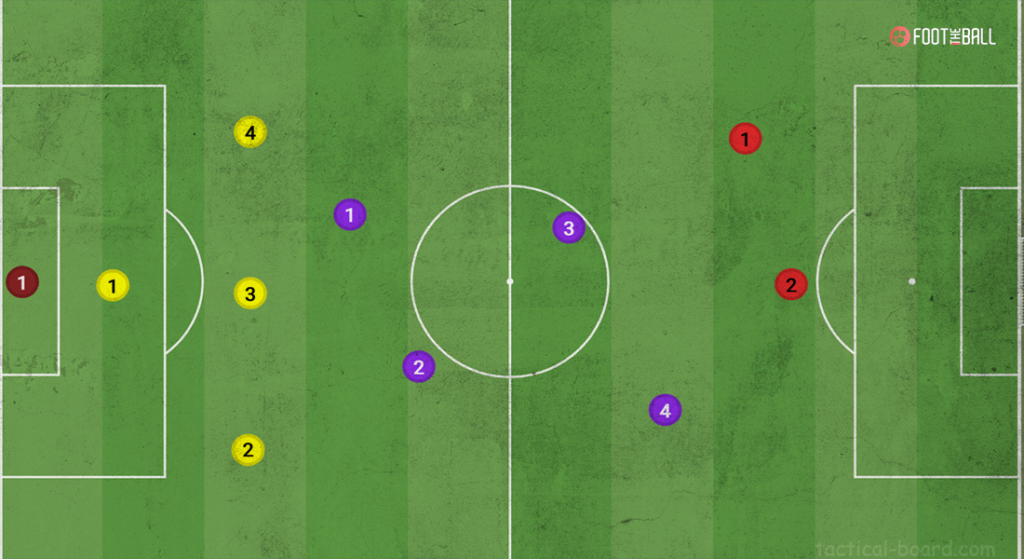
Italy took this foundation and built something entirely its own. Italian versions of Catenaccio revolved around man-marking, a compact backline, and a libero or sweeper behind the central defence. This player was not just a safety net but often the first to start a counterattack. The system required exceptional individual defenders, tactical discipline, and acute spatial awareness.
The Architects Who Built Catenaccio Into a National Identity
Two names stand above all others in shaping this system into a winning formula.
Highly influential Italian coach Nereo Rocco implemented similar ideas at Triestina, developing Ivano Blason into arguably the world’s first widely celebrated libero and managing a shock second-place Serie A finish as a result. Rocco later joined AC Milan, where he introduced similar tactical ideas and won two Serie A titles, three Coppa Italia titles, two European Cups, two European Cup Winners’ Cups, and an Intercontinental Cup.
The system was then adopted by various managers across Italy, following the decision of Argentine-French coach Helenio Herrera to use it at Internazionale, leading the club to a number of Serie A championships in the 1960s. Herrera’s version was particularly sophisticated. His Grande Inter side did not merely defend, they suffocated opponents and struck with clinical speed on the counter. The system became a badge of honour, something uniquely Italian in character even if it had foreign roots.
Serie A in the 1960s and 1970s: Catenaccio at Its Peak
The 1960s were the golden decade for defensive Italian football on the European stage. Clubs like Inter Milan and AC Milan used the system to dominate continental competition. But the 1970s brought a different kind of richness to Serie A.
The 1970s were a transformative decade for Serie A, combining tactical sophistication, the rise of new stars, and intense competition among clubs. The era is often remembered for the widespread adoption of Catenaccio, defensive discipline, and strategic play, yet it also witnessed the emergence of attacking talents who dazzled fans.
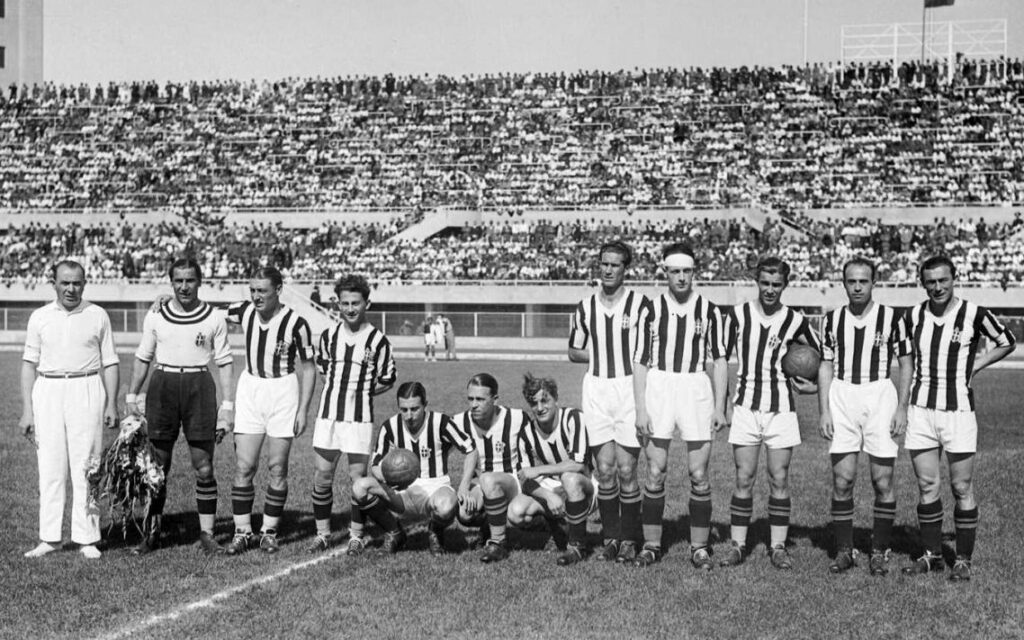
Juventus clearly emerged as the dominant force during the decade, securing five titles, while Lazio and Torino enjoyed memorable victories. Catenaccio remained prominent, though teams increasingly blended defensive discipline with attacking flexibility.
This blending was a sign of things to come. The system was beginning to bend under the pressure of new ideas from across Europe.
The Challenge: Total Football and the Cracks in the Wall
In 1972, Michels’ Ajax defeated Inter 2–0 in the European Cup final, and Dutch newspapers announced the “destruction of Catenaccio” at the hands of Total Football. The following year, Ajax defeated Milan 6–0 in the second leg of the European Super Cup, which was the worst defeat for an Italian team in a UEFA competition final.
These results forced Italian football to look inward. As man-marking alone was insufficient to cope with the fluidity of Total Football, coaches began to create a new tactical system that mixed man-marking with zonal defence, which came to be known as zona mista, meaning “mixed zone” in Italian.
The 1992 back-pass rule also accelerated change. Goalkeepers had to be more involved with their feet, which required defenders who could play forward, not just clear danger. The old libero role was becoming extinct. A new kind of defender was needed, one who could read the game, build from the back, and press when required.
Arrigo Sacchi and the Revolutionary AC Milan
If one man can be credited with dragging Italian football into the modern era, it is Arrigo Sacchi. His AC Milan side of the late 1980s and early 1990s was a seismic shift. Sacchi combined strong defensive organisation with pressing and a high tempo, creating a hybrid that drew from Catenaccio’s core principles while pushing the tactical envelope.
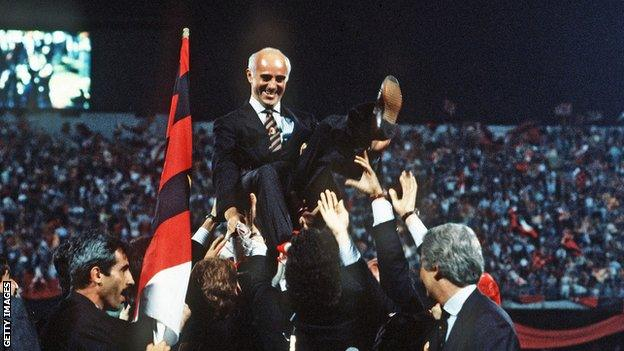
Milan under Sacchi played a flat back four, applied pressure high up the pitch, and worked in organised defensive lines. Players like Franco Baresi redefined what a modern defender could be. Baresi’s leadership and defensive prowess transformed AC Milan into a fortress during its glory days, and with an innate understanding of Catenaccio tactics, he redefined the role of a modern defender.
This era proved that Italian football could be both defensively elite and aesthetically exciting — a duality that would define Serie A’s identity for years ahead.
The 3-5-2 and Italian Tactical Innovation
While Catenaccio gets most of the headlines, Italy’s tactical contribution to world football goes well beyond one system. Italian football also pioneered the modern 3-5-2 formation, which brought a fresh perspective to the game’s tactical landscape. This formation employed three central defenders, with two wing-backs tasked with providing width and supporting both attack and defence, allowing for greater control in midfield.
Teams like AC Milan and Juventus found great success with this formation, as it offered flexibility, solidity, and the ability to quickly transition from defence to attack. The 3-5-2 formation remains a popular choice for many teams worldwide, a testament to the lasting impact of Italian tactical innovation.
Here is a quick overview of how Serie A’s core tactical systems evolved across decades:
| Era | Dominant System | Key Characteristic |
|---|---|---|
| 1950s–60s | Catenaccio | Deep defence, man-marking, libero sweeper |
| 1970s | Zona Mista | Blend of man-marking and zonal defence |
| Late 1980s–90s | Flat Back Four + Pressing | High line, organised press, transitions |
| 2000s | 3-5-2 / 4-3-1-2 | Midfield control, wing-backs, structured attack |
| 2010s–Present | High Press + Possession | Proactive, positional, fast transitions |
Modern Italian Football: Pressing, Possession, and Identity
Serie A has undergone a remarkable tactical evolution, embracing a more balanced and dynamic approach that marries defensive solidity with attacking flair. Central to this evolution was a shift from the traditional libero role to a more versatile centre-back pairing capable of initiating attacks, facilitating a more fluid transition from defence to attack.
Teams began to adopt a more proactive approach, seeking to control games through possession and applying pressure high up the pitch to recover the ball quickly.
The modern Inter Milan under Simone Inzaghi is perhaps the best example of how far things have travelled. Defenders move boldly forward when in possession, while opponents are ideally not allowed into the game at all thanks to tactical tricks and hard running, a far cry from the bolt-the-door mentality of the 1960s, yet still recognisably Italian in its discipline and organisation.
What Remains of Catenaccio in Today’s Game
The original Catenaccio system no longer exists in its pure form. But its DNA is everywhere in Italian football. Players like Fabio Cannavaro, Giorgio Chiellini, and Leonardo Bonucci exemplified the blend of grit, intelligence, and anticipation rooted in the tradition of Catenaccio.
The sweeper role, once central to Catenaccio, has evolved into the modern centre-back, who is expected to contribute both defensively and in build-up play. The principles, organisation, spatial awareness, reading the game, have simply been rewired for a faster, more fluid sport.
The use of a deep-lying playmaker, the importance of defensive organisation, and the emphasis on counter-attacking have all become integral parts of modern football strategies. Italy did not invent these principles, but it refined them into an art form that the rest of the world studied and copied.
Serie A’s Enduring Tactical Legacy
Catenaccio was never just about sitting deep or killing games. At its best, it was a structured response to the chaos of open play, a form of tactical engineering that prized control over spectacle. Its disappearance was not due to failure but to the natural evolution of football.
What Serie A has achieved across seven decades is not the loyalty to one system, but a relentless willingness to think about football differently. From the defensive genius of Nereo Rocco to the pressing revolution of Arrigo Sacchi to the elegant, high-tempo football of today’s best Italian sides, the league has always been a place where tactics matter deeply.
That intellectual seriousness, the idea that football is as much a game of the mind as of the feet — is perhaps the greatest gift Italy has given to world football. And it shows no sign of fading.







No Comments