
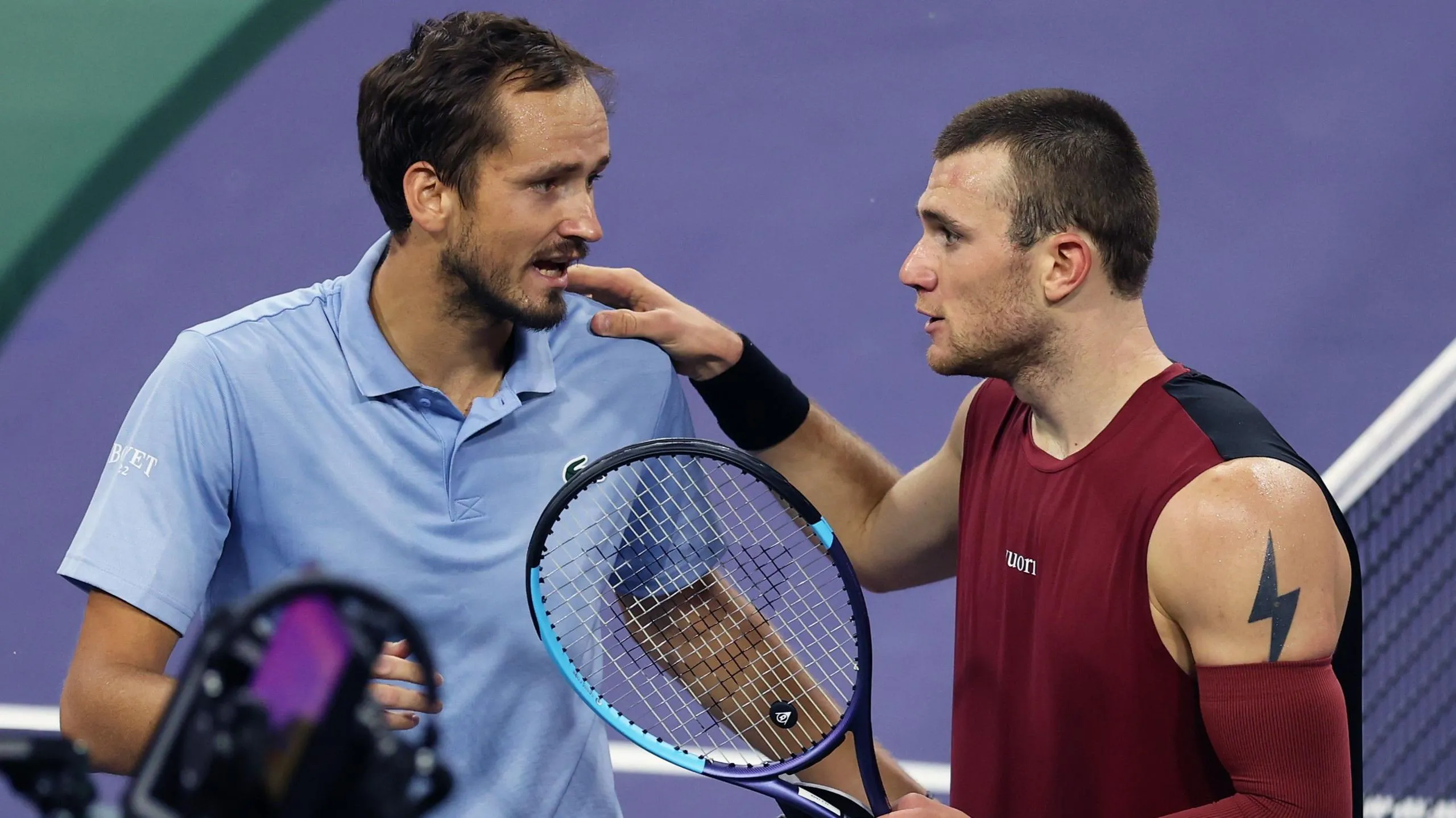

Daniil Medvedev is through to the Indian Wells final. He beat defending champion Jack Draper 6-1, 7-5 on Thursday. And almost nobody is talking about how well he played.
Table of Contents
Instead, tennis is consumed by a single moment — a raised arm, a video review, and a point that arguably decided the match. The Medvedev Draper hindrance controversy at Indian Wells has cracked open one of the sport’s most uncomfortable questions: are players now allowed to weaponise the rulebook?
What Actually Happened
The decisive moment came late in the second set with the score locked at 5-5, 0-15 on Draper’s serve. During a rally, Draper raised his arms after returning a shot, momentarily believing Medvedev’s forehand had landed long. The rally continued for three more shots before Medvedev eventually hit the ball into the net.
Instead of accepting the lost point, Medvedev turned to chair umpire Aurelie Tourte and requested a video review, claiming Draper’s gesture had distracted him.
Tourte reviewed the footage and ruled in Medvedev’s favour, explaining: “Mr. Draper made a gesture with his hand which is different than in a normal point. Therefore this is considered a hindrance.” The point was awarded to Medvedev. He broke serve immediately after. The match was effectively over.
Draper’s Response Said Everything
Draper was calm but unmistakably furious.
“Players do this all the time,” he told Tourte at the chair. “There’s no way it distracted him enough. We played two shots afterwards. I think you’ve got that wrong.“
At the net after the match, Draper told Medvedev: “You won the match fair and square, but I don’t think it distracted you.” He then shook hands with both Medvedev and the umpire and walked off without another word. The crowd, however, was far less composed — booing Medvedev loudly at the change of ends and again when he sealed the victory.
Medvedev Admitted He Didn’t Feel Great About It
To his credit, Medvedev did not pretend the incident was clean. He just refused to apologise for using the rules available to him.
“I have a good relationship with Jack. I don’t think this incident influenced the outcome. I told the chair umpire that if she didn’t consider the distraction enough, then it should be 15-15 and we keep playing. I don’t feel good about what happened, but I also don’t think I cheated.”
“If you look at the first forehand I did after it happened, I think I could have done a better shot if there was no gesture from Jack,” he added, offering his only real justification for why the review was warranted.
It was a carefully worded defence. But the timing of the appeal — after the point was already lost — is what has tennis talking.
Even Sabalenka Said It Out Loud
World No. 1 Aryna Sabalenka was asked about the incident and did not hold back.
“What I think is really awkward is you can finish the point and then ask for that,” she said, pointing directly at the rule that allowed Medvedev to wait until after the rally ended before requesting a review.
“About Daniil, theoretically he made the move, but I don’t think it actually bothered Daniil that much,” she added. Sabalenka went further, arguing that if a player is genuinely distracted, they should stop play immediately and request a review in real time, not wait to see whether they win or lose the point first.
The implication was clear. Medvedev would likely have said nothing had he won that rally.
The Rulebook Loophole Nobody Wants to Talk About
The hindrance rule itself is not new — but the ability to request a video review after the point ends is where this gets dangerous.
Under Rule 7.22(F) of the ATP Tour’s 2026 Rulebook, a hindrance refers to any situation where a player is distracted by something outside their control, including body movements and loose items. According to video review procedures at Indian Wells, reviews can be sought after point-ending shots or if a player immediately stops play.
The umpire is required to give the benefit of the doubt to the appealing player when reviewing hindrance calls, a standard that critics argue is dangerously open to exploitation when the appeal comes after the outcome of the point is already known.
Did It Actually Cost Draper the Match
This is the question that cuts through all the noise — and the honest answer is probably yes.
Draper had clawed back to 5-5 in the second set despite clearly feeling the physical effects of his gruelling three-set win over Djokovic less than 24 hours earlier. The 24-year-old was visibly weary, still feeling the strain of a two-hour 35-minute battle that ended only the evening before. At 5-5 and 0-15 down on serve, holding that game was everything.

Instead, the point was handed to Medvedev. He broke. He served out the match. He is in the final.
Tennis Has a Problem It Can No Longer Ignore
The Medvedev Draper hindrance controversy at Indian Wells will not disappear quietly. Calls for the ATP to revise the video review protocol for hindrance rulings are growing louder, with players and coaches pointing out that allowing an appeal after the point ends creates an obvious incentive to game the system.
Medvedev goes into Sunday’s final against Jannik Sinner as a legitimate contender and a deeply polarising figure this week. Draper goes home wondering what might have been.
And somewhere in the rulebook, a loophole sits quietly — waiting for the next player brave enough, or calculating enough, to use it.







No Comments