

Tennis has always been a sport where the tools matter as much as the talent. The racket in a player’s hand, the strings across its frame, the shoes on the court — every single piece of equipment has undergone dramatic transformation since the game was first codified in the 1870s. What began with heavy wooden frames and rudimentary stringing is now a precision engineering exercise involving aerospace-grade materials, biomechanical research, and data-driven design.
Table of Contents
- How Tennis Equipment Evolution Began with the Wooden Racket Era
- The Shift to Metal and Composite Frames
- How Graphite Rackets Changed Tennis Forever
- String Technology and Its Role in Tennis Equipment Evolution
- The Tennis Ball and Court Surface Transformations
- Footwear and Apparel as Part of the Modern Tennis Equipment Story
- What Today’s Modern Technology Means for the Future of Tennis Equipment
- The Enduring Impact of Tennis Equipment Evolution on the Game
This is the full story of tennis equipment evolution, and how every major shift rewrote what was possible on court.
How Tennis Equipment Evolution Began with the Wooden Racket Era
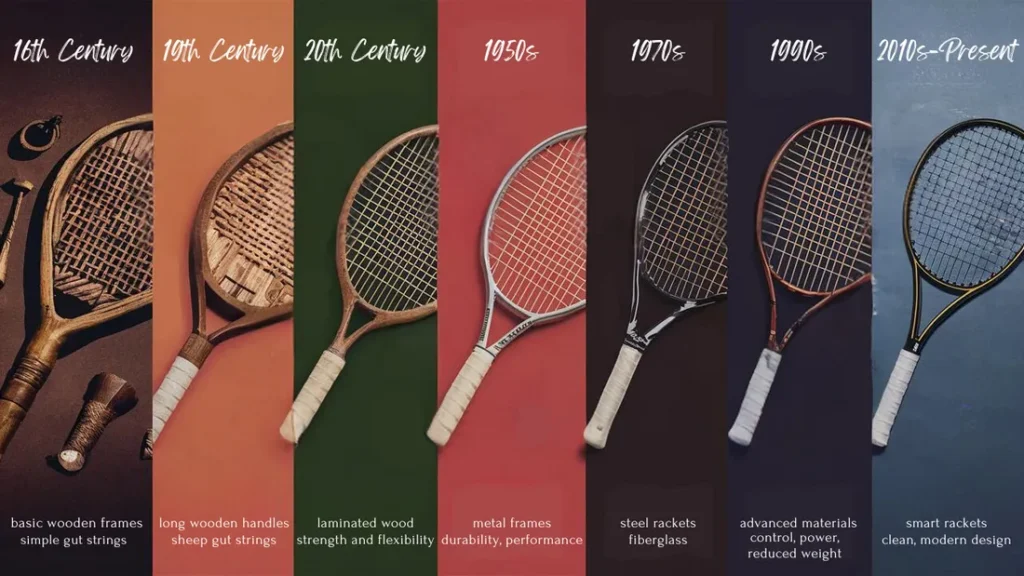
The earliest tennis rackets were handcrafted from ash or beech wood, laminated in thin layers and pressed into shape over weeks. They were heavy by modern standards, typically weighing around 380 to 420 grams, with small heads measuring approximately 65 square inches and very little flexibility in the frame. Players adapted their entire game around these limitations, relying on flat, controlled strokes and net approaches because the equipment simply could not generate the power or spin that modern tennis demands.
Despite their constraints, wooden rackets produced some of the most technically precise players the sport has ever seen. Rod Laver, Ken Rosewall, and Billie Jean King built careers of extraordinary quality using nothing more than crafted wood and natural gut strings. The limitations of the equipment shaped a playing style defined by touch, placement, and strategic intelligence rather than raw power.
The Shift to Metal and Composite Frames
The first serious challenge to wooden racket dominance came in the late 1960s when metal frames began appearing on tour. Wilson’s T2000 steel racket, famously used by Jimmy Connors throughout the 1970s, was one of the earliest metal frames to gain widespread visibility at the professional level. It offered a larger sweet spot and more consistent response across the stringbed compared to wood, though it introduced its own set of vibration issues that players had to manage.
Aluminum frames followed, offering a lighter alternative that brought the racket to a broader recreational market. These composite and metal designs bridged the gap between the wooden past and the technological future, making the game more accessible to casual players and planting the seed for the revolution that was coming.
How Graphite Rackets Changed Tennis Forever
The arrival of graphite frames in the late 1970s and through the 1980s is the single most consequential moment in tennis equipment history. Howard Head’s oversized Prince Classic, introduced in 1976, paired a dramatically enlarged head size with composite materials and fundamentally altered what players could achieve. Graphite offered a combination of stiffness, low weight, and power transmission that no previous material had come close to matching.
By the mid-1980s, graphite had effectively displaced every other material at the professional level. Rackets dropped to between 270 and 310 grams, head sizes expanded to between 95 and 110 square inches, and serve speeds climbed in ways that rewrote the statistical record books. The power baseline game that defines modern professional tennis — the heavy topspin forehands, the 200 km/h serves, the relentless groundstroke exchanges — became possible only because graphite made it structurally achievable.
String Technology and Its Role in Tennis Equipment Evolution
Racket frames receive most of the attention in any discussion of tennis equipment evolution, but string technology has been equally transformative. Natural gut, made from cow intestine, was the original stringing material and remained the professional standard for over a century due to its unmatched feel and tension maintenance. Many professionals still use natural gut in hybrid setups today because no synthetic material has fully replicated its responsiveness.
The pivotal shift came with the widespread adoption of polyester strings from the 1990s onward. Polyester is stiffer and holds tension differently from natural gut, allowing players to swing harder and generate extreme topspin without losing control. Rafael Nadal’s ability to produce topspin at rates previously unseen in professional tennis is directly tied to this string technology. Luxilon, a Belgian brand, became the dominant polyester string manufacturer on tour and effectively helped define the physical, high-spin baseline game that characterises the modern era.
The Tennis Ball and Court Surface Transformations
Equipment evolution in tennis extends well beyond the racket. Tennis balls became pressurized as standard through the early twentieth century, and the introduction of fluorescent yellow balls at Wimbledon in 1986, replacing the traditional white, improved television visibility and became the global standard. Ball felt technology has continued to be refined across manufacturers to account for altitude, humidity, and the specific demands of different court speeds.
Court surfaces themselves have evolved in parallel with racket and ball technology. The proliferation of hard courts globally from the 1980s onward created a medium-paced playing environment that suited the power game that graphite rackets enabled. Grass courts have been modified over decades to play faster and lower, while clay remains the surface most resistant to equipment-driven power, rewarding endurance and spin in ways that keep tactical diversity alive across the professional calendar.
Footwear and Apparel as Part of the Modern Tennis Equipment Story
The technological revolution in tennis equipment is not limited to rackets and strings. Footwear has become one of the most engineered components in a professional player’s arsenal. Court-specific tennis shoes now feature herringbone outsoles for clay, modified tread patterns for hard courts, and reinforced lateral support structures designed around the specific movement demands of each surface. Brands invest heavily in biomechanical research to reduce injury risk while maximising court coverage speed.
Performance apparel has undergone an equally significant transformation. Moisture-wicking fabrics, compression technology, and heat regulation materials mean that players in today’s game are better physically supported by their clothing than any previous generation. What a player wears on court is now as technically considered as what they hold in their hand.
What Today’s Modern Technology Means for the Future of Tennis Equipment
The next phase of tennis equipment evolution is already underway. Babolat launched the first commercially available smart racket, the Babolat Play, in 2013, embedding sensors in the handle to capture data on swing speed, ball impact position, shot type, and rally statistics. The data generated by these tools is now being used by coaches and performance analysts to personalise training programmes in ways that were previously impossible.
Artificial intelligence is beginning to influence racket and string design, modelling how different material combinations perform under specific playing conditions before a physical prototype is ever produced. Wearable technology integrated into apparel and footwear monitors biomechanical data in real time during match play. The equipment is no longer just a tool. It is increasingly a data collection platform.
The Enduring Impact of Tennis Equipment Evolution on the Game
Every major shift in tennis equipment evolution has done more than change performance metrics. It has changed who can play, how they play, and which styles of tennis are viable at the highest level. Wooden rackets rewarded artistry and precision. Graphite rewarded athleticism and power. Modern string technology rewarded spin and physicality. Each transition opened the game to new kinds of players and new tactical possibilities while closing off others.
Tennis equipment evolution is not a story with a final chapter. The materials will become lighter, the data more precise, the engineering more personalised, and the boundaries of what is physically possible on a tennis court will continue to be pushed outward. What began with a craftsman pressing wood into shape in a workshop is now a global industry at the intersection of material science, biomechanics, and athletic performance. The racket has always mattered. It always will.






No Comments