
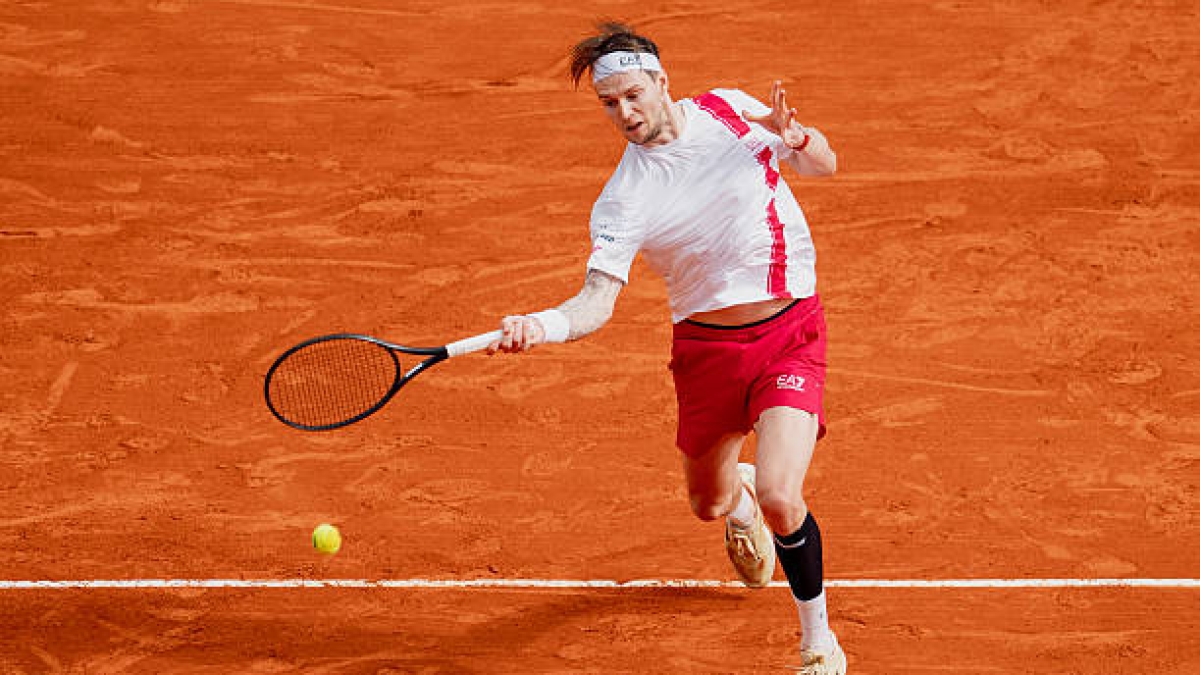

There are players who tolerate clay, and there are players who thrive on it. For much of his career, Alexander Bublik belonged firmly in the first category. A serve-heavy, hard-court specialist with a flair for the dramatic and a reputation for unpredictability, the Kazakh was not the kind of player you expected to make deep runs on the red dirt of Monaco. That narrative is now officially over.
Table of Contents
- The Man and the Surface: Understanding Why This Run Matters
- Round Two: Ending Monfils’ Monaco Chapter
- Round Three: The Statement Win Against Lehecka
- The Quarter-Final: Alcaraz Delivers a Reality Check
- The Tactical Evolution: What Changed and Why It Worked
- Bublik’s Monte-Carlo 2026 at a Glance
- What This Means for the Rest of the Clay Season
- Final Thoughts: A Clay-Court Transformation That Is Here to Stay
At the Rolex Monte-Carlo Masters 2026, Bublik reached his first-ever quarter-final at an ATP Masters 1000 event on clay, defeating experienced opponents, producing some of the most visually striking tennis of the entire tournament, and confirming that his 2025 clay breakthroughs were not a one-season anomaly. The run ended against world number one Carlos Alcaraz, but the statement had already been made long before that quarter-final scoreline was posted.
This is the full story of Alexander Bublik’s Monte-Carlo Masters 2026 campaign, match by match, moment by moment, and what it tells us about where his career is genuinely heading.
The Man and the Surface: Understanding Why This Run Matters
To appreciate what Bublik achieved in Monaco, you need to understand the journey that brought him there. Born in Russia and representing Kazakhstan since 2017, Bublik turned professional in 2016 and broke into the top 100 by 2019. His game was built around an enormous serve, inventive shot-making, and a style of play that kept opponents and spectators permanently unsure of what was coming next.
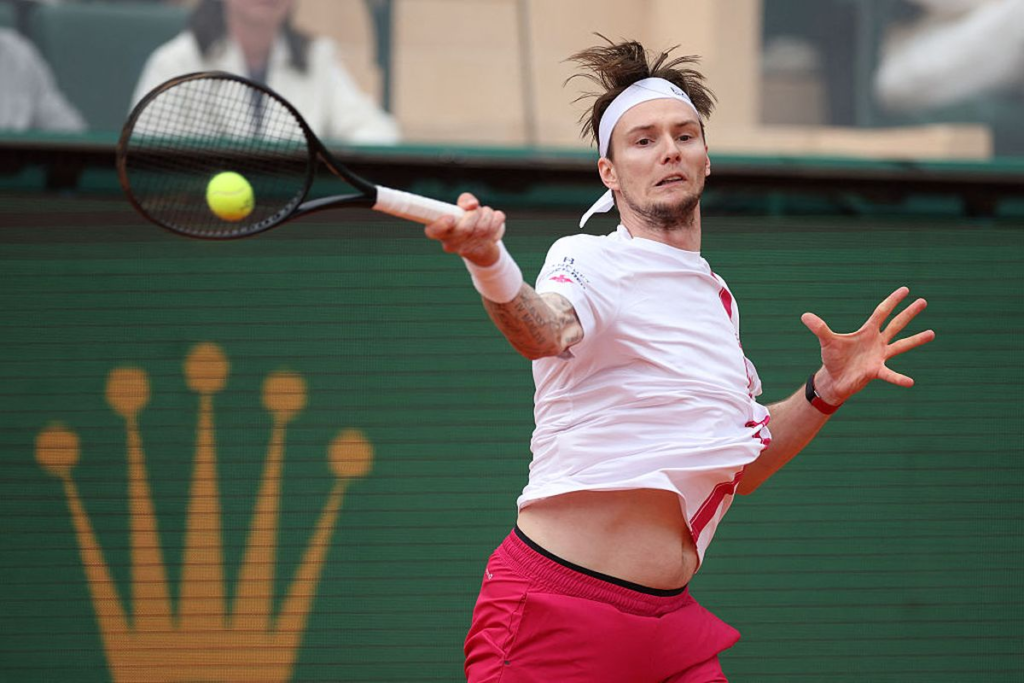
Clay, however, was the surface that exposed his weaknesses most visibly. The slower pace removes the serve-and-win shortcuts that suit his game on hard courts. The extended rallies demand endurance and footwork that did not come naturally to him. For years, clay court events were treated as something to get through rather than compete in.
That changed in 2025. Bublik reached the Roland Garros quarter-finals and claimed back-to-back titles at Gstaad and Kitzbühel, two clay events that require exactly the kind of sustained baseline engagement he had previously struggled with. By the time he arrived at Monte-Carlo in 2026 as the eighth seed, he carried a level of surface-specific confidence that was genuinely new.
The results that followed validated every bit of it.
Round Two: Ending Monfils’ Monaco Chapter
Bublik’s most emotionally charged match of the tournament came in the second round against French veteran Gaël Monfils, a player who has delighted Monte-Carlo crowds for years and whose appearance in the 2026 draw carried the feel of a potential farewell at 39 years old.
Sentiment, however, does not win tennis matches. Bublik won 6-4, 6-4 in one hour and 17 minutes, and the manner of the victory was as impressive as the scoreline suggests. The key statistic told the story clearly: Bublik won 72 percent of points on his second serve compared to Monfils’ 40 percent, a gap that reflects complete service dominance even on a surface that typically neutralises big servers.
The match produced several moments that circulated widely across social media and highlight packages. A classy forehand winner struck with precise timing past a scrambling Monfils drew gasps from the crowd. Drop volleys played from the baseline, a shot that requires both the audacity to attempt it and the technique to execute it under pressure, left the Monaco faithful appreciating what they were watching even as their favourite was being outplayed.
Monfils received warm applause as he left the court. But Bublik’s precision and controlled aggression had made the outcome feel inevitable from the middle of the first set onward.
Round Three: The Statement Win Against Lehecka
If the Monfils victory demonstrated Bublik’s capability, his third-round performance against Jiri Lehecka was the match that genuinely reframed expectations for the rest of the tournament.
Lehecka, the eleventh seed and a player who had recently reached the Miami Open final, represented a significantly higher level of opposition. A powerful ball-striker with excellent movement and the kind of aggressive baseline game that tends to expose opponents who lack defensive solidity, the Czech was widely expected to test Bublik severely and potentially end his run.
Instead, Bublik produced one of the finest clay-court performances of his career. The first set was almost shockingly comfortable, with Bublik racing to a 6-2 win by dominating the key moments with a combination of heavy topspin, flat winners, and intelligent slice that collectively prevented Lehecka from ever settling into a rhythm. Lehecka responded with genuine quality in the second set, pushing to 7-5 and making Bublik work for every point. The Kazakh held firm.
The final score of 6-2, 7-5 sent Bublik into his maiden Monte-Carlo quarter-final, and the highlights from the match were remarkable. One-handed backhand winners struck on the stretch drew immediate comparisons to Roger Federer. Sharp angled passing shots disrupted Lehecka’s court positioning. The shot variety on display was exactly the kind of performance that convinces observers a player has genuinely evolved rather than simply caught a fortunate draw.
The Quarter-Final: Alcaraz Delivers a Reality Check
Every good story needs an honest chapter, and Bublik’s Monte-Carlo Masters 2026 campaign delivered one in the quarter-finals. World number one Carlos Alcaraz, the defending champion and widely considered the finest clay-court player in the world in 2026, won 6-3, 6-0 in just over an hour.
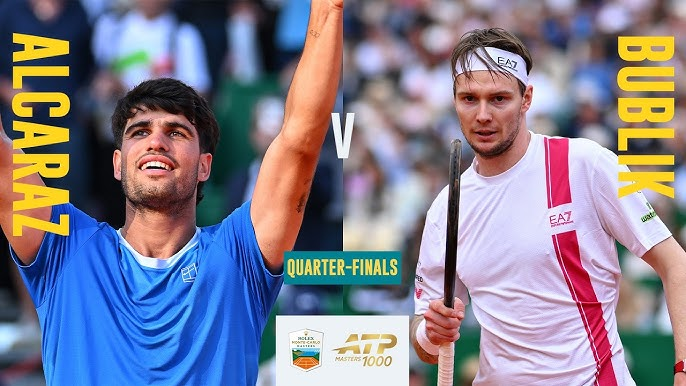
The first set offered brief hope. Bublik broke back after conceding an early deficit and temporarily levelled the momentum, showing the kind of competitive instinct that had served him so well in the previous rounds. But Alcaraz’s consistency, his explosive movement across the clay, and his ability to dictate the pace and direction of rallies from any position on the court gradually wore down Bublik’s resistance.
The Spaniard won the final ten games of the match without conceding another, dropping just three games in total. Bublik’s usually unpredictable, freewheeling game appeared subdued in the face of an opponent who had an answer for every creative option he tried. After the match, Alcaraz showed genuine sportsmanship by apologising at the net for the one-sided scoreline, an acknowledgement that the scoreboard did not fully reflect the competitive respect between the two men.
For Bublik, the defeat was disappointing but not deflating. Losing to the world number one on his preferred surface in a tournament where nobody else had dominated so completely is context worth keeping.
The Tactical Evolution: What Changed and Why It Worked
The most interesting question raised by Bublik’s Monte-Carlo Masters 2026 run is not what happened but how it happened. What specifically has changed in his game that made these results possible on a surface that once exposed him so regularly?
The answer lies across several interconnected improvements that, taken together, represent a genuinely different player from the one who used to treat clay season as an inconvenience.
Footwork and defensive sliding have improved significantly. Better sliding movement across the clay allowed Bublik to recover positions and extend rallies that he would previously have conceded. Against Lehecka in particular, his ability to retrieve difficult balls and reset the point demonstrated a level of physical preparation that was simply not present in earlier seasons.
Shot variety has always been part of his game but is now deployed with greater tactical intelligence. Drop shots, disguised backhands, and sharp angles are not just entertainment on Bublik’s current clay-court game plan. They are deliberate tactical tools designed to disrupt baseline players who prefer consistent, predictable patterns.
Second serve reliability remained a crucial foundation even on clay. Winning 72 percent of second-serve points against Monfils is not a figure that happens by accident. It reflects a serve that has been refined for slower conditions, with placement and spin variation compensating for the reduced pace advantage the surface creates.
Mental composure in tight moments, particularly in the second set against Lehecka, showed the maturity that was sometimes absent from his earlier clay-court performances. Rather than reaching for high-risk low-percentage shots when under pressure, he trusted the process and constructed points with patience.
Bublik’s Monte-Carlo 2026 at a Glance
| Round | Opponent | Score | Key Stat |
|---|---|---|---|
| Second Round | Gaël Monfils | 6-4, 6-4 | 72% second-serve points won |
| Third Round | Jiri Lehecka (11) | 6-2, 7-5 | Career-best clay Masters performance |
| Quarter-Final | Carlos Alcaraz (1) | 3-6, 0-6 | First meeting with world number one |
What This Means for the Rest of the Clay Season
The broader implications of Bublik’s Monte-Carlo Masters 2026 performance extend well beyond Monaco. The European clay swing continues through Madrid and Rome before culminating at Roland Garros, and Bublik now enters each of those events carrying a level of surface-specific confidence and ranking momentum that makes him a genuine threat.
At Roland Garros specifically, his improved clay credentials and current ranking position him as one of the most dangerous floaters in the draw. A player capable of defeating top-ten opponents on clay, who possesses the shot-making ability to win points that more conventional players cannot, and who has demonstrably improved his mental resilience in tight situations is exactly the kind of player that disrupts seedings and produces upset results at Grand Slam level.
For Kazakh tennis as a broader entity, Bublik’s continued rise at the top level of the sport has an importance that extends beyond individual results. In a country with limited tennis infrastructure, his visibility and success create pathways and inspiration for younger players who need visible proof that the sport offers a viable elite career.
Final Thoughts: A Clay-Court Transformation That Is Here to Stay
Alexander Bublik’s Monte-Carlo Masters 2026 run was many things simultaneously. It was a career milestone, his deepest result at a Masters 1000 event on clay. It was a tactical statement, demonstrating an evolved, more complete game that no longer treats the surface as a weakness to manage. And it was genuinely entertaining, producing highlight moments that reminded a global audience why Bublik remains one of the most watchable players on the ATP Tour.
The loss to Alcaraz provided context without diminishing anything. When the world number one on his best surface delivers a near-perfect performance, losing is not a failure. It is information.
As the red clay season continues and Roland Garros approaches, the question is no longer whether Bublik can compete on clay. That has been answered. The question now is how deep he can go when everything clicks at once. After Monte-Carlo 2026, the answer feels genuinely open-ended for the first time in his career.




No Comments