
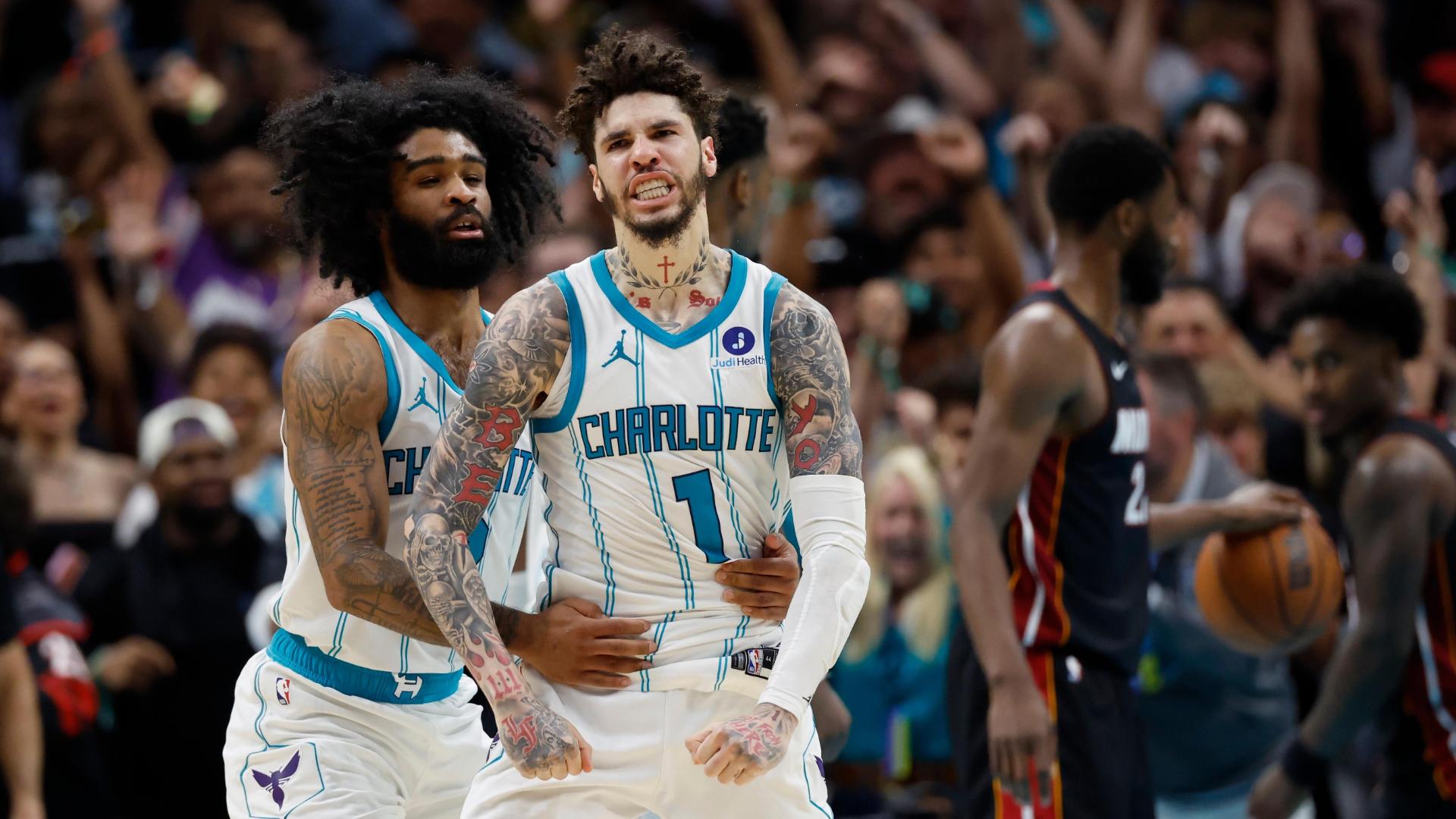

The 2026 NBA Play-In Tournament wasted no time delivering must-watch basketball. On April 14, the Charlotte Hornets edged the Miami Heat 127-126 in a breathtaking overtime contest at the Spectrum Center, a game that will be discussed for years as a defining moment for Charlotte’s young core. LaMelo Ball’s clutch layup with 4.7 seconds remaining and Miles Bridges’ game-saving block at the buzzer wrote the final chapter of one of the most dramatic elimination games in recent memory.
Table of Contents
- Final Score Breakdown: A Game That Had Everything
- Quarter-by-Quarter Scoring
- Key Stats Comparison: Where the Hornets Won the Battle
- Team Statistical Comparison
- Top Individual Performers
- LaMelo Ball: The Select Yourself Moment That Decided It All
- Miles Bridges: Defensive Anchor and Two-Way Force
- The Block That Sealed Everything
- Brandon Miller’s Quiet Excellence
- Tactical Breakdown: Why the Hornets Select Themselves as a Legitimate Contender
- Charlotte’s Four Winning Tactics
- Where Miami Fell Short
- Playoff Implications: What This Win Means for the Eastern Conference
- Bold Predictions: What Happens Next
- Conclusion: Select Yourself or Go Home
But beyond the highlight reel moments, this game carried a deeper message: select yourself. The Hornets refused to wait for anyone’s approval, validation, or ideal bracket positioning. They chose their own fate in the final minutes when the margin for error was essentially zero. That kind of self-belief, channeled through disciplined execution, defensive grit, and star-level clutch performance, is exactly what separates playoff teams from lottery teams in today’s NBA.
Charlotte (now 45-38) advances to face the loser of the Philadelphia 76ers vs. Orlando Magic matchup on Friday, April 17. The winner of that contest claims the East’s No. 8 seed and a first-round appointment with the top-seeded Detroit Pistons. Miami, meanwhile, heads to the draft lottery after a resilient but ultimately heartbreaking season.
Here is everything you need to know about the game, the key performers, the tactical story, and what it all means for the Eastern Conference playoff picture.
Final Score Breakdown: A Game That Had Everything
Nineteen lead changes. Ten ties. Regulation ending deadlocked at 118-118. These numbers alone tell you why this game was special. Both teams played with the kind of urgency that only single-elimination basketball produces, and neither was willing to blink first until Ball forced the issue in overtime.
Quarter-by-Quarter Scoring
| Period | Charlotte Hornets | Miami Heat |
|---|---|---|
| Q1 | 32 | 28 |
| Q2 | 30 | 35 |
| Q3 | 28 | 29 |
| Q4 | 28 | 26 |
| OT | 9 | 8 |
| Total | 127 | 126 |
Charlotte controlled the first quarter with aggressive perimeter defense and crisp ball movement. Miami answered in the second and third periods through sharper half-court execution and interior leverage from Bam Adebayo. The fourth quarter was a chess match, with both teams trading punches before the Hornets’ composure ultimately forced overtime. In those five extra minutes, Charlotte’s depth, length, and Ball’s relentless energy proved to be the difference.
Key Stats Comparison: Where the Hornets Won the Battle
Numbers never lie in close games. The margins here were thin, but Charlotte’s advantages in several categories compounded into a decisive victory.
Team Statistical Comparison
| Statistic | Charlotte Hornets | Miami Heat | Edge |
|---|---|---|---|
| Field Goal % | 48.9% | 47.3% | Hornets |
| 3-Point % | 38% (19/50) | 34% (12/35) | Hornets |
| Free Throw % | 80% (24/30) | 81% (26/32) | Heat |
| Rebounds | 48 | 44 | Hornets |
| Assists | 32 | 28 | Hornets |
| Turnovers | 14 | 16 | Heat |
| Steals | 8 | 7 | Hornets |
| Blocks | 7 | 4 | Hornets |
Charlotte’s superior three-point volume (50 attempts vs. Miami’s 35) was a calculated tactical choice that stretched Miami’s defense and created driving lanes throughout the night. The Hornets also dominated the glass by four boards, which translated directly into second-chance opportunities in clutch moments. Miami’s edge at the free-throw line was negated by Charlotte’s turnover advantage and blocked shot differential.
Top Individual Performers
| Player | Team | Points | Assists | Rebounds | Other |
|---|---|---|---|---|---|
| LaMelo Ball | Hornets | 32 | 11 | 7 | 4 steals |
| Miles Bridges | Hornets | 28 | 3 | 9 | 3 blocks |
| Brandon Miller | Hornets | 23 | 5 | 5 | Efficient shooting |
| Tyler Herro | Heat | Strong output | — | — | Led Miami scoring |
| Bam Adebayo | Heat | Solid contribution | — | Double-double threat | Interior presence |
LaMelo Ball: The Select Yourself Moment That Decided It All
There are players who shrink in elimination games and players who grow. LaMelo Ball belongs firmly in the second category. His 32-point, 11-assist, 7-rebound performance was the kind of line that redefines how a franchise thinks about its future.
With 4.7 seconds left in overtime and Charlotte trailing by one, Ball attacked the rim without hesitation. No committee decision, no deferring to a veteran presence. He selected himself as the player who would decide this game, and he delivered. That layup gave Charlotte a lead they would not surrender.
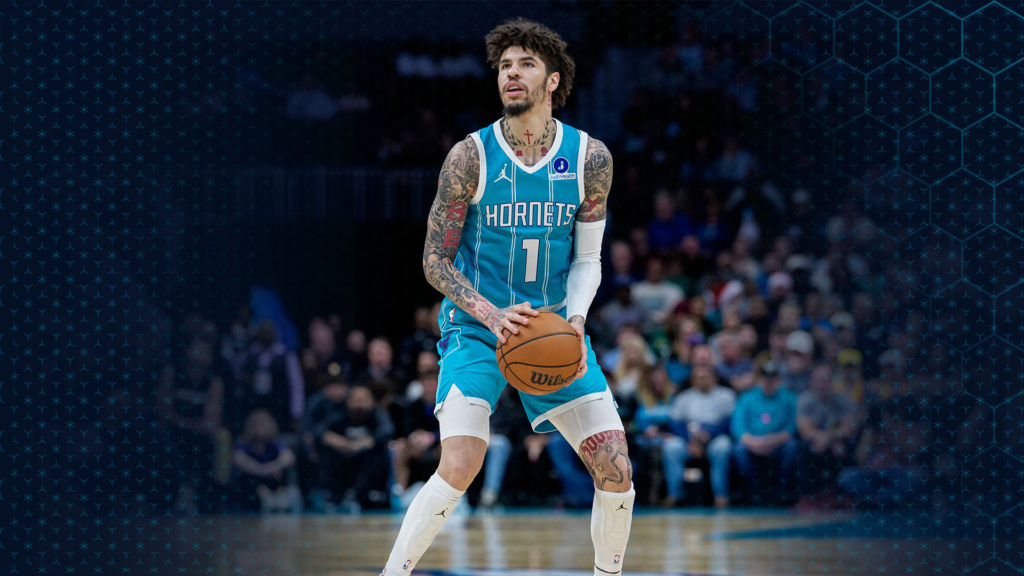
Ball became just the second player in Play-In Tournament history (alongside Josh Giddey) to record 30-plus points, 10-plus assists, and 5-plus rebounds in a single game. His game-winner is also the first in the final 10 seconds of any Play-In contest, placing him in rare historical company at just 24 years old.
What makes Ball’s performance even more impressive is the context. This was an elimination game on home floor, with an entire fanbase’s season resting on every possession. He finished through contact, made the right reads against double-teams, and never let the moment feel too big. That is the mark of a genuine franchise player.
Miles Bridges: Defensive Anchor and Two-Way Force
LaMelo Ball may have provided the headline, but Miles Bridges ensured the game actually ended the right way. His 28-point, 9-rebound, 3-block performance showcased exactly the kind of two-way versatility that modern NBA teams covet in their forwards.
The Block That Sealed Everything
With the Hornets clinging to a one-point lead in the game’s final seconds, Miami pushed the ball up court looking for a miracle. Bridges read the play perfectly, tracked the ball handler, and rejected the potential game-tying layup cleanly at the rim. It was an elite athletic play made in the highest-pressure situation imaginable.
That block did not happen by accident. Bridges has spent considerable effort rebuilding his reputation and refining his defensive instincts over the past two seasons. His ability to guard multiple positions, contest shots without fouling, and contribute on the boards makes him one of the more underrated two-way forwards in the Eastern Conference.
Brandon Miller’s Quiet Excellence
Brandon Miller’s 23-point, 5-rebound, 5-assist night may not generate the same attention as Ball’s heroics or Bridges’ block, but it was absolutely essential to Charlotte’s victory. Miller knocked down timely threes when Miami’s defense collapsed on Ball, and he made smart reads as a secondary creator when the Hornets needed offensive relief.
Miller’s development alongside Ball and Bridges is the real story of Charlotte’s immediate future. When all three are producing on the same night, this team becomes genuinely difficult to guard. That balanced scoring threat is precisely what will make Friday’s game so interesting.
Tactical Breakdown: Why the Hornets Select Themselves as a Legitimate Contender
Great teams do not win close games by accident. Charlotte had specific tactical reasons for this victory, and understanding those reasons explains why this team may be more dangerous than people realize heading into the final Play-In round.
Charlotte’s Four Winning Tactics
- Floor Spacing Through Three-Point Volume — Fifty three-point attempts forced Miami’s defense to spread thin, opening the paint for Ball and Bridges to attack. Charlotte was not just shooting threes randomly; they were using them as a deliberate tool to disorganize Miami’s interior protection.
- Switchable Defensive Scheme — The Hornets switched effectively on pick-and-roll actions from the second quarter onward, preventing Miami from generating easy mismatches. Ball, Miller, and Bridges all have the length and lateral quickness to disrupt at the point of attack.
- Transition Offense — Charlotte converted Miami turnovers into fast-break points at a strong rate. Sixteen Miami turnovers created consistent early-offense opportunities that the Hornets’ athletes were perfectly designed to exploit.
- Late-Game Decision Making — In possessions that mattered most, Charlotte consistently made the simpler, higher-percentage play. Miami, by contrast, forced contested looks when the shot clock tightened. Composure under pressure decided this game as much as any individual talent.
Where Miami Fell Short
Miami’s strengths, specifically interior control and veteran experience, were gradually neutralized as Charlotte increased the pace. When the game moved away from deliberate half-court offense, the Heat struggled to generate clean looks. Tyler Herro carried the scoring load admirably, but without a consistent second creator in crunch time, Miami’s offense became predictable and stoppable.
Playoff Implications: What This Win Means for the Eastern Conference
This victory does not just keep Charlotte’s season alive. It reshapes the Eastern Conference’s lower bracket in meaningful ways.
Charlotte’s Path Forward
The Hornets now face the loser of the 76ers-Magic game on Friday, April 17. Win that, and they earn the No. 8 seed and a first-round matchup against the Detroit Pistons (60-22, East’s top seed). Lose it, and the season ends.
Detroit is formidable, but their youth and relative lack of deep playoff experience creates genuine vulnerability. A Hornets team riding momentum, with Ball performing at this level, could absolutely push the Pistons to five or six games. That possibility alone makes Friday’s contest must-watch television.
Miami’s Offseason Questions
For the Heat, the questions now shift entirely to roster construction. A 43-39 regular season record shows resilience, but the team must address perimeter athleticism and secondary scoring this summer. Erik Spoelstra remains one of the NBA’s elite coaches, and Bam Adebayo provides a reliable foundation. However, surrounding those assets with younger, more dynamic talent must be the priority heading into 2026-27.
Eastern Conference Playoff Standings Context
| Seed | Team | Record | First Round Opponent |
|---|---|---|---|
| 1 | Detroit Pistons | 60-22 | No. 8 seed (TBD) |
| 2 | Boston Celtics | TBD | No. 7 seed (TBD) |
| 7 | TBD (76ers or Magic) | TBD | No. 2 seed |
| 8 | TBD (Hornets or opponent) | TBD | Detroit Pistons |
| Eliminated | Miami Heat | 43-39 | Draft lottery |
The Play-In format continues to prove its value by creating exactly these kinds of consequential, high-drama games. Casual fans tune in, stars emerge, and the playoff field gains genuine unpredictability.
Bold Predictions: What Happens Next
Based on what we saw on April 14, here are three forward-looking assessments worth tracking:
- Charlotte beats their Friday opponent — The momentum, home crowd energy, and Ball’s current form make the Hornets a slight favorite regardless of who they face. Teams playing their best basketball at the right moment are dangerous in single-elimination formats.
- LaMelo Ball earns All-Star consideration next season — If he continues performing at this level into the playoffs, the conversation around his tier as a player will shift significantly. A 32-point, 11-assist elimination game performance commands serious respect.
- Detroit gets tested in Round 1 — The Pistons’ regular-season dominance was built against a full schedule. A hungry, athletic Hornets squad with nothing to lose could expose weaknesses that did not show up in the standings.
Conclusion: Select Yourself or Go Home
The 2026 NBA Play-In Tournament delivered its first instant classic, and the lesson embedded in every fourth-quarter possession and overtime moment was clear. Select yourself. Do not wait for ideal circumstances, favorable matchups, or the perfect moment. Charlotte’s Hornets decided they were a playoff team and played like it when everything was on the line.
LaMelo Ball’s game-winner, Miles Bridges’ sealing block, and Brandon Miller’s steady excellence were not accidents. They were the product of a young team that has genuinely bought into its identity and plays with conviction.
Friday’s game will tell us even more about what this Hornets squad is capable of. But regardless of what happens next, April 14, 2026 was the night Charlotte announced itself to the Eastern Conference.
What do you think? Can the Hornets pull off another upset on Friday and earn the No. 8 seed? Do they have what it takes to challenge Detroit in the first round? Drop your thoughts in the comments below and stay with our NBA section for full Play-In coverage, first-round previews, and expert analysis throughout the 2026 playoffs.


No Comments