


The 2026 FIFA World Cup is the most significant structural change in the tournament’s 96-year history. For the first time ever, 48 nations will compete for football’s ultimate prize, up from the 32-team format that has been in place since 1998. Co-hosted across Canada, Mexico, and the United States from June 11 to July 19, 2026, this edition represents a deliberate and historic push toward global football inclusivity.
Table of Contents
- The Complete FIFA World Cup 2026 Qualified Teams List by Confederation
- CONMEBOL: South American Royalty Qualifies in Full Force
- CONMEBOL 2026 Qualified Teams
- UEFA: Europe’s 16 Teams Include Resurgents and Playoff Survivors
- CAF: Africa’s Record 10-Team Contingent Signals a New Era
- AFC: Asia’s Nine Qualifiers Reflect Genuine Continental Growth
- CONCACAF: Beyond the Host Nations, the Field Deepens
- Debutants Spotlight: Four Nations Making World Cup History
- Cabo Verde: The Blue Sharks Arrive
- Curaçao: The Smallest Nation in World Cup History
- Jordan: Arab Resilience Earns Historic Recognition
- Uzbekistan: Central Asia’s First World Cup Nation
- Biggest Shocks: Who Is Missing and Why It Matters
- Italy’s Third Consecutive Absence
- Other Notable Absences
- What This 48-Team Field Means for the 2026 Tournament
- Conclusion: A World Cup That Reflects the Beautiful Game’s Global Reach
The FIFA World Cup 2026 qualified teams list is now complete. With 45 spots earned through gruelling continental qualifying campaigns spanning from September 2023 through to March 2026, plus the three automatic berths awarded to the host nations, every team that will appear in North America this summer has been confirmed. The qualification process involved 206 nations across six confederations, making it the most expansive qualification cycle in the sport’s history.
This article gives you the full breakdown of every qualified team by confederation, highlights the four first-time qualifiers making their World Cup debuts, analyses the biggest shocks and heartbreaks from the qualification stage, and looks ahead at what this historic 48-team field means for the tournament itself. Whether you are planning your viewing schedule or simply want to understand how the field came together, this is your complete guide.
The Complete FIFA World Cup 2026 Qualified Teams List by Confederation
The 48 qualified teams are distributed across six confederations, with allocations reflecting both historical performance and FIFA’s push for broader representation. Here is the full breakdown of every nation that has earned their place in North America.
All 48 Qualified Teams by Confederation
| Confederation | Teams Qualified | Notable Inclusions |
|---|---|---|
| UEFA (Europe) | 16 | France, Germany, Spain, England, Portugal |
| CAF (Africa) | 10 | Morocco, Senegal, Egypt, Algeria, Côte d’Ivoire |
| AFC (Asia) | 9 | Japan, South Korea, Australia, Iran, Saudi Arabia |
| CONMEBOL (South America) | 6 | Argentina, Brazil, Colombia, Uruguay, Ecuador |
| CONCACAF (North/Central America) | 6 | USA, Mexico, Canada (hosts), Panama, Haiti, Curaçao |
| OFC (Oceania) | 1 | New Zealand |
The expansion from 32 to 48 teams primarily benefited Africa (up from 5 to 10 slots), Asia (up from 4.5 to 8.5 slots), and CONCACAF (up from 3.5 to 6 slots). This redistribution reflects where football’s fastest growth is happening and acknowledges that talent is no longer concentrated exclusively in Europe and South America.
CONMEBOL: South American Royalty Qualifies in Full Force
South America sends six teams to the FIFA World Cup 2026 qualified teams list, and the continent’s qualification story is one of sustained excellence across an unforgiving 18-match round-robin format. Every match in CONMEBOL qualifying counts, there are no easy opponents, and the margin for error across nearly three years of competition is extremely thin.

Argentina qualified with a pragmatic 0-0 draw in Bolivia in March 2025, a result that reflected their post-2022 mentality of grinding out results rather than chasing glory. As defending champions, they approached qualification with professionalism rather than panache, and it worked. Brazil followed in their traditional position near the top, while Colombia, Ecuador, Paraguay, and Uruguay all earned their spots through consistency and physicality across the full campaign.
The notable absentees are Chile and Peru, two nations with genuine football pedigree who could not secure their positions in an era where the competition has never been stronger. CONMEBOL’s single available playoff slot went unused in the direct qualification sense, meaning the top six simply outperformed everyone else across 18 matches.
CONMEBOL 2026 Qualified Teams
| Team | World Cup Appearances | Best Result | Key Player |
|---|---|---|---|
| Argentina | 18 | Winners (1978, 1986, 2022) | Lionel Messi |
| Brazil | 22 | Winners (5 times) | Vinicius Jr |
| Colombia | 7 | Quarter-finals (1994) | Luis Díaz |
| Uruguay | 14 | Winners (1930, 1950) | Darwin Núñez |
| Ecuador | 4 | Round of 16 (2006) | Moisés Caicedo |
| Paraguay | 9 | Quarter-finals (2010) | Miguel Almirón |
UEFA: Europe’s 16 Teams Include Resurgents and Playoff Survivors
Europe retains the largest allocation in the FIFA World Cup 2026 qualified teams list, with 16 nations earning their place across a combination of direct qualification groups and a four-round playoff system. The UEFA allocation reflects the confederation’s depth, but the playoff stage also exposed genuine frailties in some of the continent’s most historically significant footballing nations.
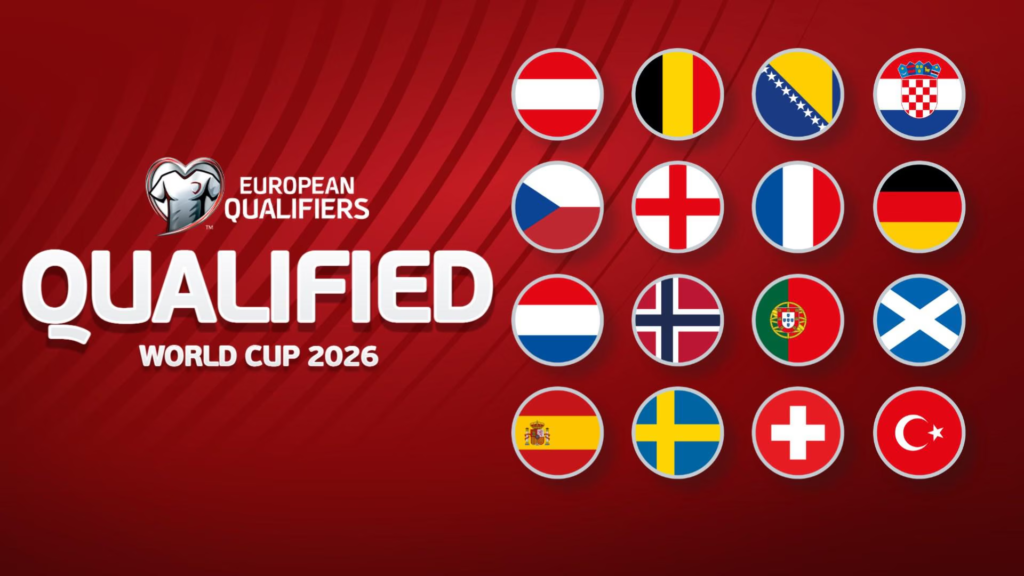
The direct qualifiers read like a who’s who of international football’s elite: France, Germany, Spain, England, Portugal, Netherlands, Belgium, Croatia, Austria, Norway, Scotland, and Switzerland all secured their spots through group stage performance. The playoff route then delivered Sweden, Türkiye, Czechia, and Bosnia and Herzegovina as the final four European qualifiers.
Bosnia and Herzegovina’s playoff victory over Italy on penalties was the single most discussed result of the entire global qualification process, and it is covered in greater detail in the surprises section below. Scotland’s playoff qualification adds emotional resonance for a nation with a passionate football culture that has historically struggled on the biggest stages.
Key UEFA Qualified Teams Overview
| Team | Qualification Route | World Cup Appearances | Tournament Pedigree |
|---|---|---|---|
| France | Direct | 16 | Winners 1998, 2018 |
| Germany | Direct | 20 | Winners 4 times |
| Spain | Direct | 16 | Winners 2010 |
| England | Direct | 16 | Winners 1966 |
| Portugal | Direct | 9 | Semi-finals 2006 |
| Bosnia and Herzegovina | Playoff | 2 | Group stage 2014 |
| Türkiye | Playoff | 5 | Third place 2002 |
| Sweden | Playoff | 12 | Third place 1994 |
CAF: Africa’s Record 10-Team Contingent Signals a New Era
Africa has never sent more teams to a World Cup than the 10 nations confirmed in the FIFA World Cup 2026 qualified teams list. This expanded allocation is arguably the most significant beneficiary of the 48-team format, and the quality of teams that qualified reflects how far African football has developed since the continent first appeared at the tournament in 1970.
Morocco qualified first among African nations in September 2025, building directly on their extraordinary 2022 World Cup campaign where they became the first African nation to reach a semi-final. They arrive in 2026 as genuine dark horse contenders rather than romantic underdogs. Senegal, Egypt, Algeria, Ghana, Côte d’Ivoire, South Africa, Tunisia, DR Congo, and Cabo Verde complete Africa’s largest ever World Cup delegation.
South Africa’s return ends a 16-year absence from the tournament. DR Congo’s qualification is their first since 1974, when they competed under the name Zaire. These returns add historical richness to Africa’s 2026 story, sitting alongside the more consistent presences of Morocco and Senegal.
The most remarkable African qualification story belongs to Cabo Verde, who topped their qualifying group ahead of Cameroon. A volcanic archipelago nation of approximately 500,000 people, their debut is one of the tournament’s most compelling underdog narratives and is discussed fully in the debutants section.
AFC: Asia’s Nine Qualifiers Reflect Genuine Continental Growth
Asia sends nine teams to the 2026 tournament, up significantly from previous editions, and the FIFA World Cup 2026 qualified teams list reflects genuine improvement in footballing infrastructure across the continent rather than simply a mathematical reallocation of spots.
Japan led the way with early qualification in March 2025, continuing their status as Asia’s most consistent World Cup performers. Iran, South Korea, Australia, Saudi Arabia, Iraq, Jordan, Qatar, and Uzbekistan complete the AFC contingent. Qatar’s qualification via merit rather than as tournament hosts for the first time is a meaningful milestone for their programme.
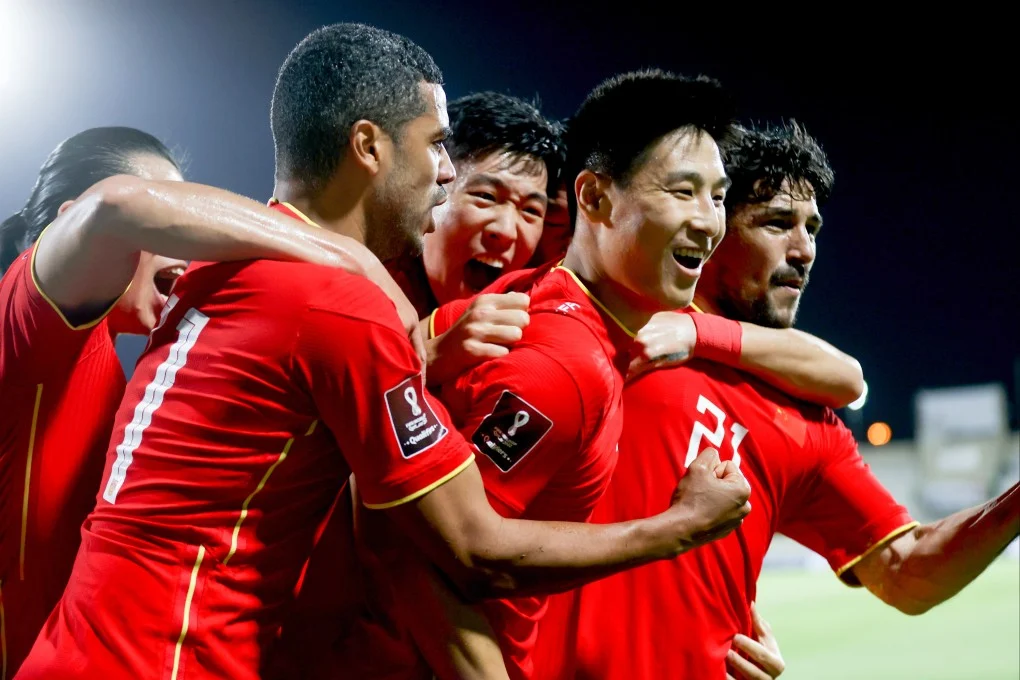
Iraq’s qualification followed a marathon 21-match campaign over 28 months, a testament to the organisational commitment their federation has made to building a competitive international programme. The presence of Jordan and Uzbekistan as first-time or relatively inexperienced qualifiers speaks to the broader development story across the continent.
CONCACAF: Beyond the Host Nations, the Field Deepens
The three host nations, United States, Mexico, and Canada, qualify automatically and bring significant weight of expectation to the tournament being played on their own soil. Canada’s back-to-back World Cup appearances mark genuine generational progress for a nation that waited 36 years between their 1986 appearance and their 2022 return.

The three non-host CONCACAF qualifiers tell a richer story about the confederation’s development. Panama returns for their second World Cup appearance. Haiti returns after a remarkable 52-year absence, their last appearance having come in 1974. Curaçao qualifies for the first time ever, becoming the smallest nation by population in World Cup history, and their story is explored in full below.
New Zealand rounds out the 48-team field as the sole OFC representative, qualifying comfortably with a 3-0 victory over New Caledonia in March 2025.
Debutants Spotlight: Four Nations Making World Cup History
One of the most compelling aspects of the FIFA World Cup 2026 qualified teams list is the presence of four nations competing at the tournament for the very first time. Each debut carries a unique story of perseverance, tactical evolution, and national pride.
Cabo Verde: The Blue Sharks Arrive
Cabo Verde’s qualification is the story of a small island nation of approximately 500,000 people outperforming one of Africa’s most celebrated footballing nations. Topping their qualifying group ahead of Cameroon required not just ability but exceptional organisation, team spirit, and tactical discipline under coach Pedro Brito.
Their squad blends local talent with diaspora players born and developed in Portugal and other European nations, giving them a technical quality that exceeds what pure domestic development could produce. They will not be favourites in any group they enter, but they arrive as one of the tournament’s most inspiring stories.
Curaçao: The Smallest Nation in World Cup History
Curaçao’s qualification via the CONCACAF Nations League pathway represents something genuinely historic. With a population of approximately 150,000, they become the smallest nation ever to qualify for a World Cup, challenging every assumption about the minimum scale required to compete at elite international level.
Their model is built on meticulous scouting of Dutch Caribbean heritage players across European leagues combined with a compact, disciplined defensive structure that makes them extremely difficult to break down. They may not advance from their group, but their presence reshapes what smaller nations believe is possible.
Jordan: Arab Resilience Earns Historic Recognition
Jordan qualified through consistent AFC third-round performances and a convincing playoff display, beating Oman 3-0 in a decisive fixture. Situated in a geographically and politically complex region, Jordanian football has developed remarkably under structured federation investment and coaching stability.
Coach Hussein Ammouta’s side favours counter-attacking football, disciplined defensive blocks, and set-piece organisation. Their debut arrives alongside Iraq and Saudi Arabia in what represents a significant moment for pan-Arab football representation at the global stage.
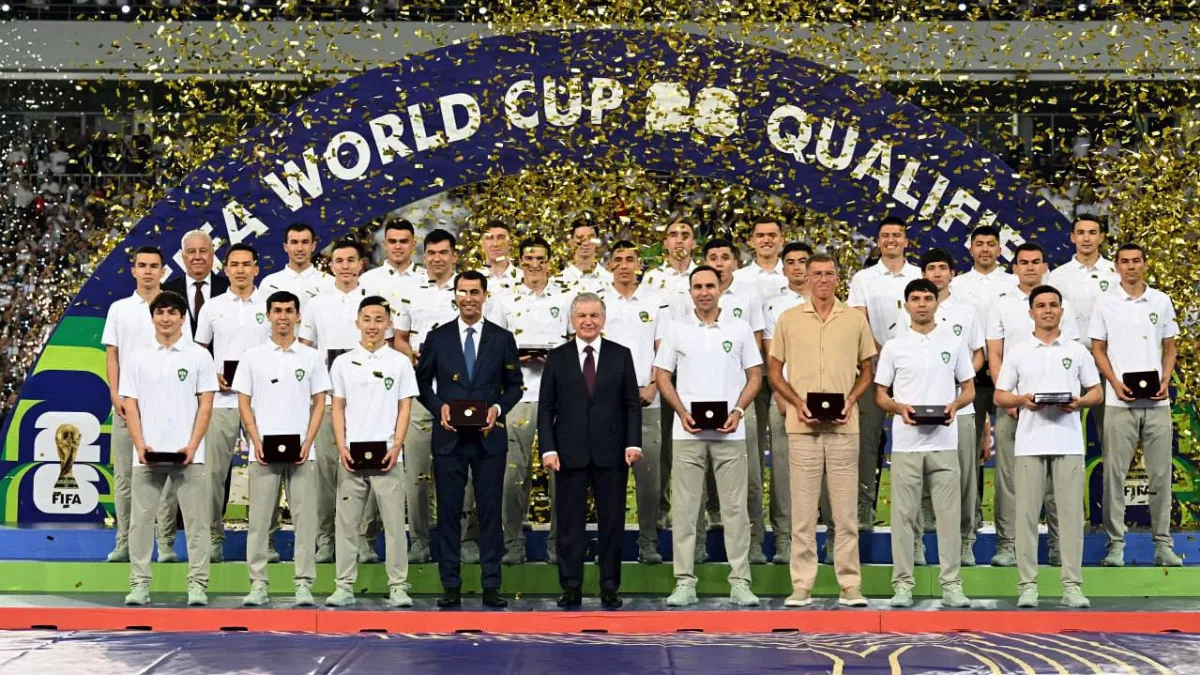
Uzbekistan: Central Asia’s First World Cup Nation
Uzbekistan’s qualification is the first by any Central Asian nation in World Cup history, and it reflects decades of investment in football academies and coaching infrastructure following the post-Soviet era. Dominating their AFC qualifying group demonstrated not just talent but the consistent quality of a programme that has matured steadily over many years.
Their presence diversifies Asia’s profile beyond the traditional East Asian powers and signals that Central Asia is a serious emerging football region that will only become more competitive over the next decade.
The Four World Cup Debutants at a Glance
| Nation | Confederation | Population | How They Qualified | Strength |
|---|---|---|---|---|
| Cabo Verde | CAF | ~500,000 | Topped CAF group ahead of Cameroon | Diaspora talent, defensive organisation |
| Curaçao | CONCACAF | ~150,000 | CONCACAF Nations League pathway | Compact defence, tactical discipline |
| Jordan | AFC | ~10 million | AFC playoffs, beat Oman 3-0 | Counter-attacking, set pieces |
| Uzbekistan | AFC | ~36 million | Topped AFC qualifying group | Technical quality, academy system |
Biggest Shocks: Who Is Missing and Why It Matters
No analysis of the FIFA World Cup 2026 qualified teams list is complete without addressing the nations whose absence will define the tournament as much as those who qualified. The expanded field did not prevent high-profile eliminations; it simply meant the qualifying bar was raised across more competitive pathways.
Italy’s Third Consecutive Absence
Italy’s failure to qualify is the biggest shock in global football. The Azzurri, ranked approximately 12th in the world and winners of Euro 2020, fell to Bosnia and Herzegovina in the UEFA playoffs, losing 4-1 on penalties after a 1-1 draw. Their third consecutive World Cup absence is a generational crisis rooted in several interconnected problems:
- Over-reliance on foreign players in Serie A has reduced pathways for young Italian talent
- Defensive tactical tradition has slowed adaptation to modern high-pressing football
- Internal distractions and squad management issues affected preparation before crucial matches
- A talent pipeline gap following the golden generation of the 2000s has never been adequately addressed
Italy last appeared at a World Cup in 2014. They will not appear in 2026. That is 16 years and counting for a nation with four World Cup titles.
Other Notable Absences
| Nation | FIFA Ranking | Eliminated By | Stage |
|---|---|---|---|
| Italy | ~12 | Bosnia and Herzegovina | UEFA Playoff |
| Denmark | ~20 | Czechia | UEFA Playoff |
| Nigeria | ~28 | Failed CAF qualification | Group stage |
| Cameroon | ~34 | Cabo Verde | CAF Group stage |
| Poland | ~26 | Failed UEFA qualification | Group stage |
Denmark’s elimination by Czechia was nearly as surprising as Italy’s exit. A nation that reached the Euro semi-finals in recent years and consistently ranks among Europe’s top 20 fell at the playoff stage in what was a genuine tactical and form-based shock.
Nigeria’s absence stings for African football given their talent pool and historical presence at the tournament. Their failure to qualify while Cabo Verde succeeded underlines that reputation no longer substitutes for organisation and consistency.
What This 48-Team Field Means for the 2026 Tournament
The complete FIFA World Cup 2026 qualified teams list tells a story that goes beyond names and numbers. It reflects football’s shifting geography, the maturation of development systems outside traditional powerhouses, and the genuine democratisation of the sport at the elite international level.
The tournament format of 12 groups of four, with the top two from each group and the eight best third-placed teams advancing to the round of 32, means fewer nations face guaranteed early elimination. This change particularly benefits debutants and smaller nations who historically lost two matches and went home before finding their feet in the competition.
From a competitive standpoint, the favourites remain predictable: France, Argentina, Brazil, Germany, Spain, and England all possess the squad depth and tournament experience to compete for the title. But the expanded field creates more pathways for upsets, more group stage matches with genuine stakes, and more opportunities for nations like Morocco, Senegal, Japan, and South Korea to advance deeper than ever before.
Bold predictions for the 2026 tournament based on the qualified field:
- Morocco reach the quarter-finals again, continuing Africa’s most remarkable run of tournament progress
- At least one debutant wins their opening group stage match, with Jordan the most likely candidate given their organised defensive structure
- The United States reach the quarter-finals driven by home crowd advantage and a genuinely talented young squad
- At least two African teams reach the round of 16, reflecting the confederation’s strongest ever qualification class
- Curaçao become the neutral fan favourite of the tournament regardless of results, purely through the inspiration of their story
Conclusion: A World Cup That Reflects the Beautiful Game’s Global Reach
The FIFA World Cup 2026 qualified teams list is more than a collection of 48 national programmes. It is a document of football’s evolution, capturing the sport’s spread from its traditional European and South American heartlands into Africa, Asia, the Caribbean, Central Asia, and the Pacific.
Italy’s absence reminds us that history and reputation offer no guarantees. Curaçao’s presence reminds us that size is no barrier to ambition. Uzbekistan’s debut reminds us that patient investment in football infrastructure eventually produces results that matter on the world stage.
From June 11, when the tournament begins across three host nations, every one of these 48 stories will begin to unfold. Some will end in heartbreak after three matches. Others will generate moments that define careers, inspire generations, and change how nations see themselves through the lens of sport.
Which nation on the FIFA World Cup 2026 qualified teams list are you most excited to watch? Do you think a debutant can cause a major upset in the group stage? Share your predictions in the comments below and explore our Football section for full tournament previews, group stage analysis, player profiles, and everything you need ahead of the most anticipated World Cup in history.






No Comments