
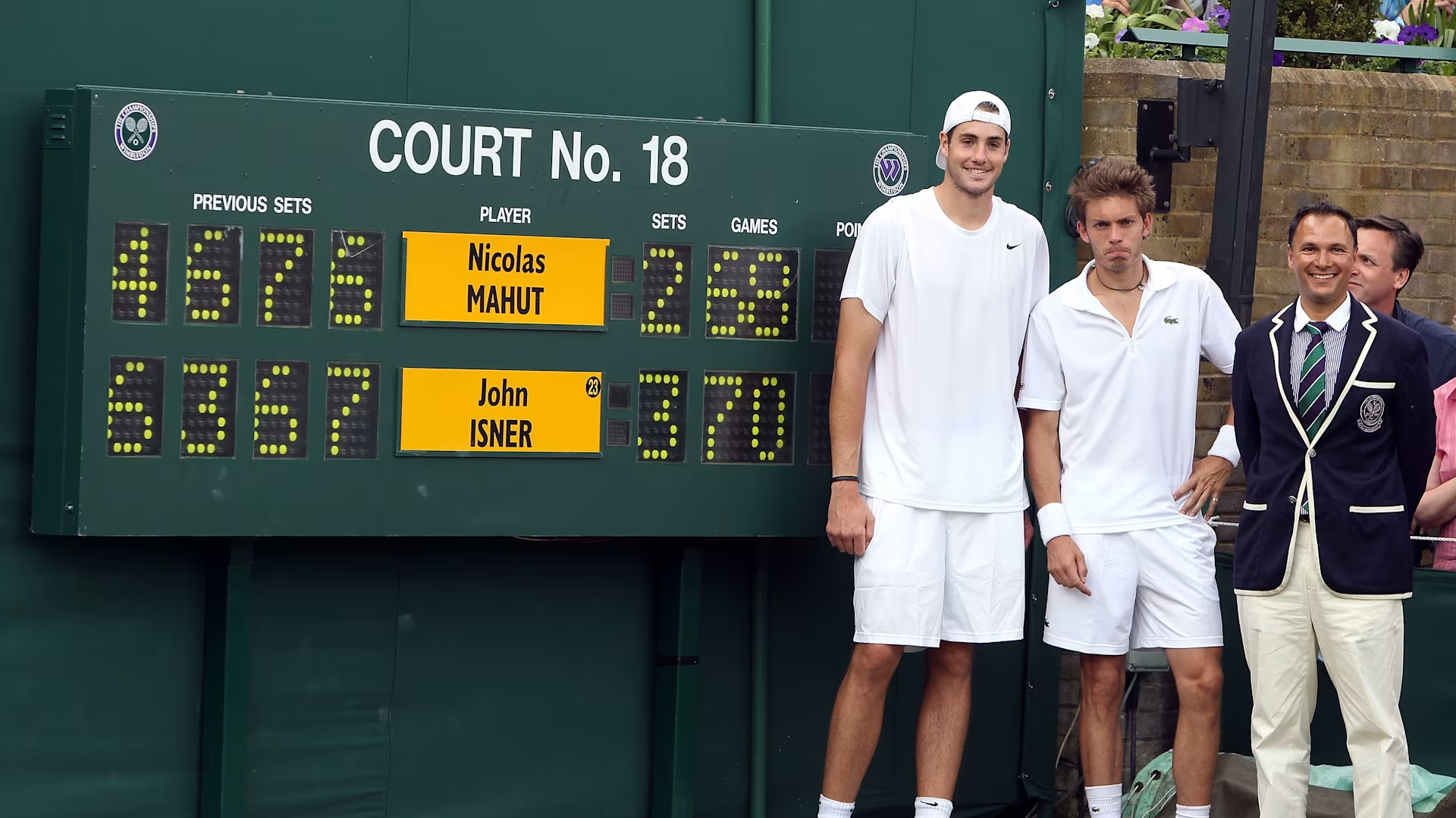

On June 22, 2010, John Isner and Nicolas Mahut walked onto Court 18 at the All England Club expecting a routine first-round match. Three days later, after 11 hours and 5 minutes of play, the tennis world had witnessed something it had never seen before. The longest tennis match ever played had just concluded, and the sport would never look at unlimited final sets the same way again.
This is the complete story, how it unfolded across three days, every record it shattered, what changed in the rules afterward, and why it remains one of the most genuinely extraordinary events in professional sports history.
In June 2010, neither competitor was among the tournament favorites. John Isner, 25 years old and from Greensboro, North Carolina, stood 6 feet 9 inches tall and was already known as one of the tour’s most powerful servers. Nicolas Mahut, 28 and French, had built a strong reputation on grass courts through a precise serve-and-volley game and exceptional tactical intelligence.
Their first-round draw placed them on Court 18, one of Wimbledon’s smaller outside courts. The modest setting attracted little initial attention. That would change within 24 hours.
The match began in the mid-afternoon and moved at a normal pace through the first four sets. Isner won the first 6-4. Mahut took the second and third 3-6 and 6-7. Isner won the fourth set tiebreak 7-6 (3). At this point the score was tied at two sets apiece, and nothing suggested the match was heading anywhere other than a standard five-set conclusion.
Then the fifth set began.
Under the rules at Wimbledon in 2010, no tiebreak was played in the deciding set. Players had to win by two clear games. With both men serving at an exceptional level, game after game went with serve. The score reached 20-20. Then 30-30. The scoreboard on Court 18, which was not designed to display games beyond 47, began struggling to keep up.
At 9:10 PM, fading light forced the umpire to suspend play with the fifth set locked at 59-59. Isner had already served more than 90 aces. The match had been going for roughly six hours and was already approaching the all-time record for match duration — but neither player had yet broken serve in the deciding set.
Word had spread overnight. When the players returned the following morning, the small outside court had become one of the most-watched spots in world sport. Spectators abandoned their seats on Centre Court to witness what was unfolding on Court 18. Television cameras from broadcasters around the world trained themselves on the scoreboard that could barely contain the numbers.
On this day, the match surpassed the previous record for the longest tennis match ever played: the 6 hours and 33 minutes Fabrice Santoro and Arnaud Clement had spent on court at the 2004 French Open. The Isner-Mahut match passed that mark and kept going without pause. Both players continued to hold serve with extraordinary consistency. Isner’s average first-serve speed exceeded 120 miles per hour throughout. Mahut answered with precision placement and aggressive net approaches.
Darkness forced a second suspension. The fifth set still stood at 59-59. Both men had now been competing across portions of two separate days and the physical toll was visible on both players, yet the quality of tennis remained remarkably high.
When the players returned for a third consecutive day, the atmosphere around Court 18 had taken on a quality that witnesses would later describe as unlike anything they had experienced at a regular-season match. Officials, journalists, and players from across the tournament grounds had gathered to watch the conclusion.
After more games of serve-holds at the highest level, Isner finally broke Mahut’s serve in the 138th game of the fifth set. After 11 hours and 5 minutes of total play — and a fifth set that alone had lasted 8 hours and 11 minutes — the longest tennis match in history was over.
Final score: John Isner defeated Nicolas Mahut 6-4, 3-6, 6-7 (9-7), 7-6 (3), 70-68.
Isner collapsed to the court. Mahut stood at the net and received a standing ovation that matched the one given to the winner. Both men understood what they had been part of.
The Court 18 scoreboard was not built to display numbers above 47 games per set. Wimbledon ground staff tracked and updated the score manually for the duration of the fifth set.
| Category | Isner-Mahut Record | Previous Record |
| Total match duration | 11 hrs 5 min | 6 hrs 33 min (2004 FO) |
| Longest final set | 8 hrs 11 min | No comparable benchmark |
| Fifth set score | 70-68 (138 games) | Never previously reached |
| Total games in match | 183 | ~40-60 in a typical 5-setter |
| Aces — Isner | 113 | Previous single-match high ~80 |
| Aces — Mahut | 103 | First time both exceeded 100 |
| Combined aces | 216 | Never approached before |
| Total points played | Isner 980 / Mahut 949 | Far beyond any prior match |
To frame the scale of what happened: the fifth set of this match, taken alone, was longer than the previous record for an entire match. The 138 games in that deciding set exceeded the total game count of most complete five-set encounters. Both players hit more aces individually than many players accumulate across an entire Grand Slam tournament draw.
No other match in professional tennis comes close in terms of total duration, but several other marathon encounters have pushed the boundaries of endurance at the Grand Slam level:
| Rank | Match / Event | Duration | Deciding Set | Notes |
| 1 | Isner vs Mahut — Wimbledon 2010 R1 | 11h 5m | 70-68 | All records still stand |
| 2 | Isner vs Anderson — Wimbledon 2018 SF | 6h 36m | 26-24 | Heat exhaustion; changed SF scheduling |
| 3 | Nadal vs Djokovic — AO Final 2012 | 5h 53m | 7-5 in 5th | Widely called greatest Grand Slam final |
| 4 | Alcaraz vs Sinner — RG Final 2025 | 5h 29m | Tiebreak decider | Longest Open Era Roland Garros final |
| 5 | Federer vs Djokovic — Wimbledon Final 2019 | 4h 57m | 13-12 TB | First Wimbledon final won by tiebreak |
The gap between first and second place captures the uniqueness of the Isner-Mahut match better than any description. It was not just the longest tennis match ever played. It was nearly twice as long as the second longest match on record.
Before the third day had even concluded, the conversation about rule reform had begun in earnest. Tennis authorities were forced to confront a question the sport had long avoided: should professional matches be allowed to continue indefinitely in the deciding set?
Nine years after the match, Wimbledon introduced a final-set tiebreak rule: if the deciding set reaches 12-12, a tiebreak is played to determine the winner. It was a historic departure from the All England Club’s traditions and it was implemented specifically because another match on the scale of Isner-Mahut was considered both a realistic possibility and an unacceptable risk to player welfare and tournament scheduling.
In 2022, all four Grand Slams agreed on a common deciding-set format. When the final set reaches 6-6, a 10-point super tiebreak determines the winner. This format now applies at the Australian Open, French Open, Wimbledon, and the US Open.
Neither rule change would have happened without the 70-68 scoreline providing an undeniable argument for reform. The match itself is the reason those rules now exist.
Isner played his second-round match less than 24 hours after the marathon ended and lost in three straight sets. No one was surprised. He went on to a long ATP career, reaching a career-high world ranking of eighth and winning multiple titles on tour before retiring in 2023.
Mahut, despite losing one of the most statistically extraordinary matches ever played, continued competing at a high level. He became one of the most decorated doubles players of his generation, winning multiple Grand Slam doubles titles. He also retired in 2023, celebrated across the tennis world as a player who had defined himself far beyond one result on Court 18.
The scoreboard from that court, displaying the iconic 70-68 score, was preserved by the All England Club and placed on permanent display at the Wimbledon Lawn Tennis Museum, where it remains one of the museum’s most visited exhibits.
More than 15 years have passed. The match has not faded into trivia. It remains a genuine reference point in how people think about endurance, competition, and what sport reveals about human character.
What made it extraordinary was not simply the duration. Long matches occur across many sports. What made this one remarkable was the quality that persisted across all three days. Neither player’s level collapsed. The tennis in the final hours was not significantly worse than the tennis in the first. Two professionals continued performing at the highest standard under conditions no training program prepares an athlete to handle.
The match produced 216 combined aces. For context, the average number of aces served across an entire five-set Grand Slam match is typically fewer than 30.
For anyone interested in what athletic competition looks like when pushed to its absolute outer limits, the longest tennis match ever played is one of the most compelling studies that professional sport has ever produced. The records it set remain untouched. The rule changes it caused are now foundational to the structure of the sport. And the match itself, 11 hours, 5 minutes, 183 games, 70-68 in the fifth remains, in a genuine and unambiguous sense, one of the most remarkable things that has ever happened in a professional sporting arena.
The longest tennis match ever played lasted 11 hours and 5 minutes across three days. It was the first-round match between John Isner and Nicolas Mahut at Wimbledon 2010, played June 22-24.
John Isner defeated Nicolas Mahut 6-4, 3-6, 6-7 (9-7), 7-6 (3), 70-68. The fifth set alone comprised 138 games and lasted 8 hours and 11 minutes.
Isner served 113 aces and Mahut served 103 aces, for a combined total of 216. It remains the first and only time in tennis history that both players in the same match exceeded 100 aces.
Wimbledon introduced a final-set tiebreak rule in 2019, triggered when the deciding set reaches 12-12. In 2022, all four Grand Slams adopted a 10-point super tiebreak at 6-6 in the deciding set. These rules prevent any match from continuing indefinitely.
The Court 18 scoreboard displaying the 70-68 score was preserved by the All England Club and is on permanent display at the Wimbledon Lawn Tennis Museum.
Yes. As of 2026, the Isner-Mahut match at Wimbledon 2010 remains the longest tennis match ever played by a significant margin. No other match in professional tennis history has come within five hours of its total duration.
The longest tennis match ever played was a collision between two evenly matched competitors under conditions the sport had no precedent for and has since taken structural steps to prevent from recurring. John Isner and Nicolas Mahut spent three days on Court 18 at Wimbledon pushing the limits of what professional tennis looks like when two players simply refuse to be broken.
The records they set — 11 hours 5 minutes, 183 games, 70-68 in the fifth set, 216 combined aces — remain untouched. The rule changes their match made necessary are now permanent features of the sport at its highest level. And the match itself continues to stand, more than 15 years later, as one of the most genuinely remarkable things that has ever happened in professional sport.
Copyright 2026 Site. All rights reserved powered by site.com





No Comments