
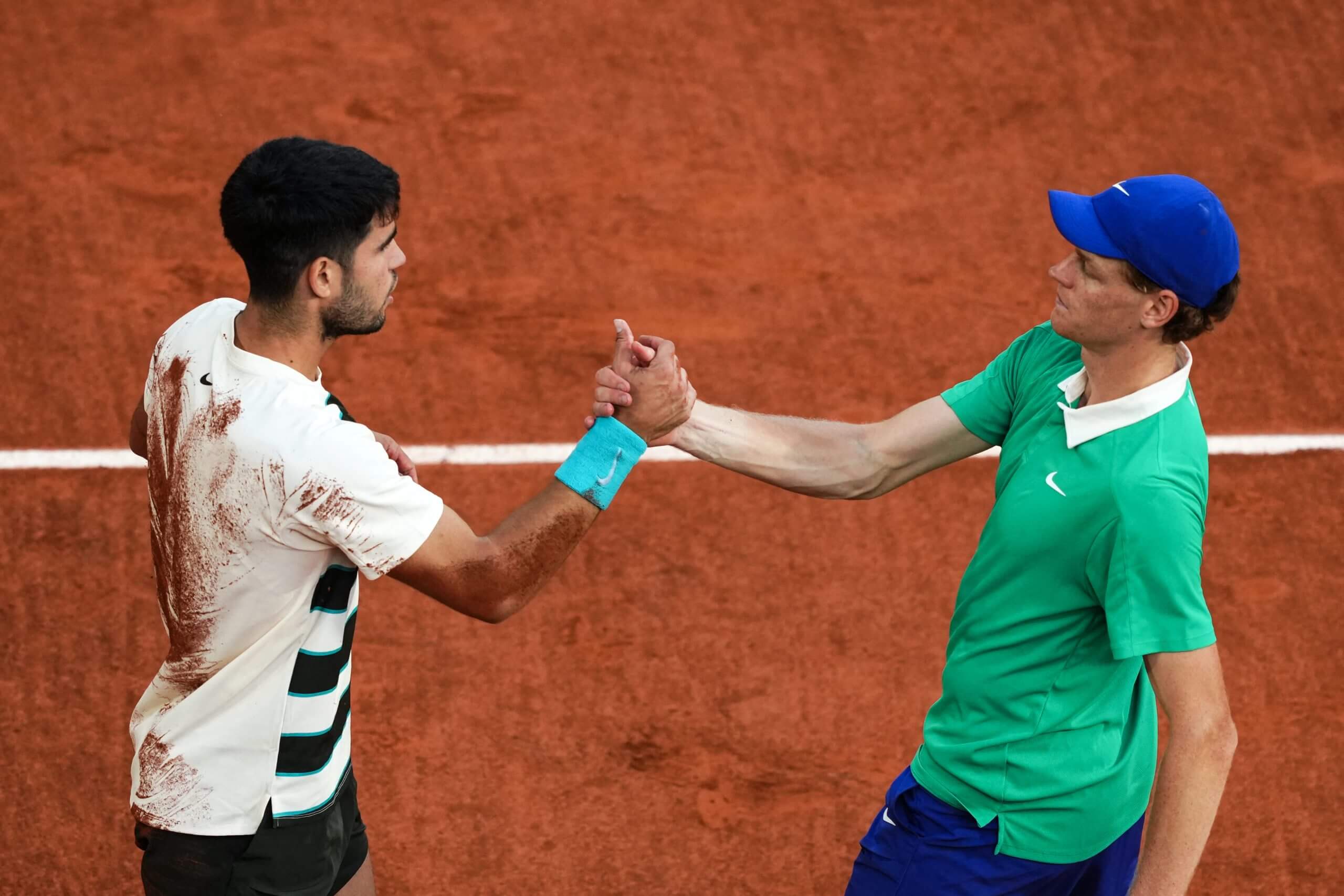

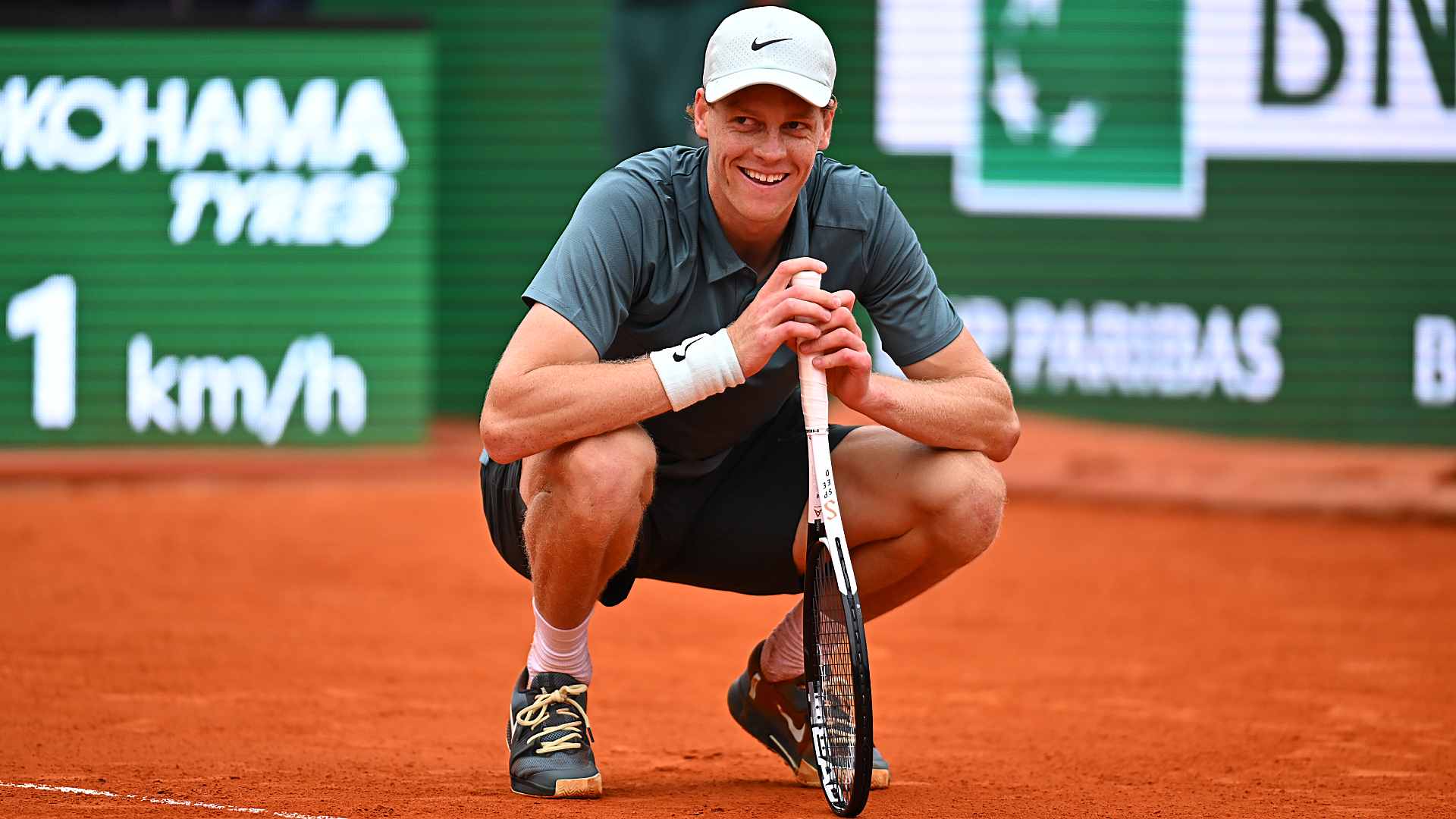
It was June 8, 2025. Roland Garros. Fourth set. Jannik Sinner was serving at 3–5, 0-40 — three consecutive championship points. The match was four hours old. Carlos Alcaraz, down two sets, looked finished. Then, inexplicably, he wasn’t.
Table of Contents
- Before the World Knew Their Names
- 2:50 AM and Five Hours of Madness
- The Rivalry Timeline: Year by Year
- The Stats That Define the Rivalry
- The Tactical Battle Beneath the Drama
- Roland Garros 2026: The Big Prediction
- What Federer–Nadal–Djokovic Started, These Two Are Continuing
- More Than a Rivalry — A Gift to the Sport
What followed over the next 89 minutes was not just a tennis match. It was a statement. Alcaraz saved all three championship points, broke Sinner’s serve, and eventually won the longest Roland Garros final in history — 5 hours and 29 minutes. Two sets down. Three match points saved. One legend confirmed.
Alcaraz vs Sinner is not a rivalry still finding its shape. It is already, by almost every statistical and cultural measure, one of the greatest the sport has ever produced. Nine consecutive Grand Slams won between them. Three Grand Slam finals in a single season. And with Roland Garros 2026 approaching, the next chapter is almost here.
Before the World Knew Their Names
The Alcaraz–Sinner head-to-head record goes back further than most fans realise. Their first meeting was at the 2019 Alicante Challenger — a 15-year-old Alcaraz beating a 17-year-old Sinner. Even then, the outline of something special was visible.
Their first ATP Tour match came at the 2021 Paris Masters, where an 18-year-old Alcaraz — ranked No. 35 in the world — upset Sinner in straight sets, knocking him out of ATP Finals contention. Weeks later, their first final at Umag went Sinner’s way, giving the Italian his first clay-court title.
After winning that Paris match, the teenage Alcaraz predicted they would build a great rivalry. He was right in a way even he probably couldn’t have imagined.
2:50 AM and Five Hours of Madness
The 2022 US Open quarterfinal is the match that announced this rivalry to the world. It lasted 5 hours and 15 minutes — a US Open record for the latest finish, ending at 2:50 AM. In a sport that has produced some of the most extraordinary endurance contests in history, this one still stands apart for its sheer quality. Alcaraz saved a match point in the fourth set and won in five. Between them they hit 124 winners and generated 42 break points. It was tennis at a level rarely seen, and the crowd knew it.
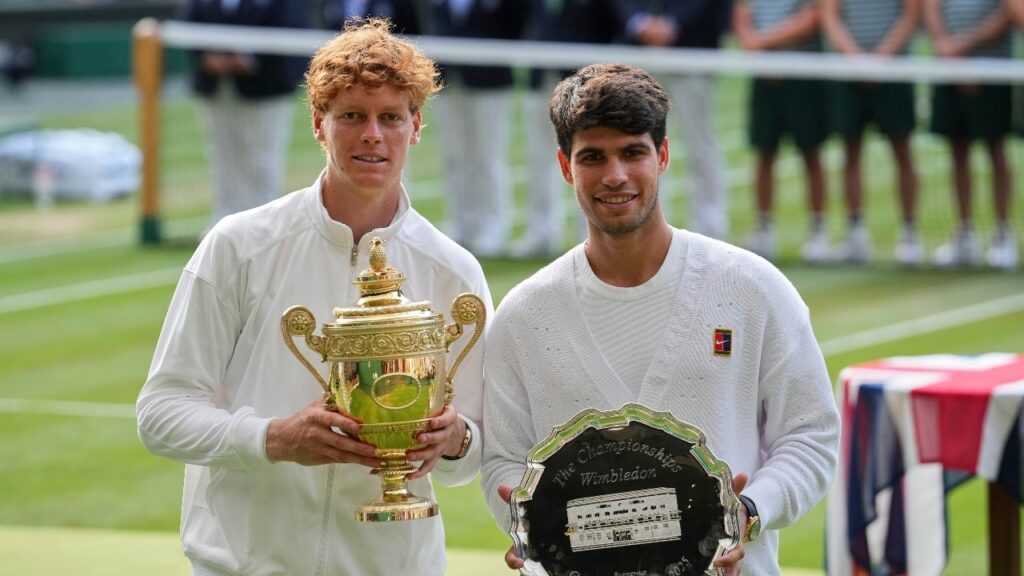
Alcaraz went on to win the tournament, claiming his first Grand Slam title and becoming — at the time — the youngest world No. 1 in history. This wasn’t simply a great match. It was the moment the next generation officially took over.
The Rivalry Timeline: Year by Year
2021 (3 meetings): Alcaraz wins the first ATP encounter in Paris. Sinner wins their Umag final. Early exchanges. No dominant force yet.
2022 (3 meetings): The US Open epic. Alcaraz wins his first Slam and No. 1 ranking. The rivalry’s defining match arrives before most people are ready for it.
2023 (3 meetings): Sinner wins two. The head-to-head sits at 4–4. Perfectly balanced.
2024 — Alcaraz Takes Control: Three meetings; Alcaraz wins all three. At Indian Wells, he snaps Sinner’s 19-match winning streak. At Roland Garros, he wins a five-set semifinal with both players dealing with injury. The China Open, Sinner leads 3–0 in the deciding tiebreak — Alcaraz wins seven straight points. After Roland Garros 2024, Sinner becomes world No. 1 for the first time.
2025 — Three Grand Slam Finals in One Season: This had never happened before in the Open Era.
- Roland Garros Final: Alcaraz def. Sinner 4–6, 6–7(4), 6–4, 7–6(3), 7–6(10–2). The match is 5 hours and 29 minutes — the longest French Open final in history, decided by a super tiebreak for the first time ever in a French Open singles final.
- Wimbledon Final: Sinner def. Alcaraz 4–6, 6–4, 6–4, 6–4. Five weeks after Paris. Sinner becomes the first Italian man to win Wimbledon. He wins 84% of first-serve points. Alcaraz suffers his first career Grand Slam final defeat.
- US Open Final: Alcaraz def. Sinner 6–2, 3–6, 6–1, 6–4. Dominant. 42 winners to Sinner’s 21. Zero double faults. Alcaraz returns to No. 1.
- ATP Finals (November, Turin): Sinner def. Alcaraz 7–6, 7–5. A reminder: Sinner always answers.
2026 — Alcaraz Makes History: At the Australian Open final on February 1, Alcaraz defeated Novak Djokovic 2–6, 6–2, 6–3, 7–5 to complete the career Grand Slam — becoming the youngest man in tennis history to win all four majors at 22 years and 272 days old. He broke a record held by Rafael Nadal, and one that had stood since Don Budge in 1938. Together, Alcaraz and Sinner have now won nine consecutive Grand Slams.
The Stats That Define the Rivalry
| Stat | Alcaraz | Sinner |
|---|---|---|
| Overall H2H | 11 wins | 8 wins |
| Grand Slam titles | 7 | 4 |
| ATP Ranking (March 2026) | No. 1 | No. 2 |
| Grand Slam finals record | 7–1 | 4–1 |
| Clay H2H | Alcaraz leads | — |
| Grass H2H | — | Sinner leads (2–0) |
| Hard court H2H | Alcaraz leads | — |
Perhaps the most remarkable statistic: across all six of their 2025 meetings — all of which were finals — the total points won for the entire year were Alcaraz 1,651, Sinner 1,651. Perfectly tied.
Nine consecutive Grand Slams between two players has only been achieved once before: Federer and Nadal, from 2010 to 2012. Alcaraz and Sinner are 22 and 24 years old.
The Tactical Battle Beneath the Drama
Alcaraz is the most complete player in the game — dominant on clay, exceptional on grass and hard courts, and statistically unmatched in the longest matches. His career record in fifth sets is 12–1. He is, simply, the best closer in tennis.
Sinner is the most consistent ball-striker in men’s tennis. On fast surfaces, he is as close to a machine as the sport allows — a flawless baseline game, an elite serve at his best (as evidenced by that 84% first-serve points figure at Wimbledon 2025), and a mental composure that almost never cracks. Of his 24 career titles, 21 are on hard courts.
The one well-documented weakness in Sinner’s game is extended matches. He has never won a match lasting over 3 hours and 50 minutes. Alcaraz, in contrast, was 12–1 in fifth sets heading into 2026.
On clay, Alcaraz is superior. On grass, Sinner has beaten Alcaraz both times they’ve met. And hard courts, Alcaraz leads but Sinner is dangerous. This is what makes the rivalry genuine: there is no dominant surface equation.
Roland Garros 2026: The Big Prediction
Roland Garros 2026 begins in late May. The stakes are extraordinary.
Alcaraz will be chasing a third consecutive Roland Garros title — which would make him only the second man in history to achieve three straight French Open wins, after Rafael Nadal. Sinner will be chasing the one Grand Slam missing from his collection — and a career Grand Slam of his own.
The case for Alcaraz: Clay is his best surface. He is undefeated against Sinner at Roland Garros in both the 2024 semifinal and the 2025 final. His fifth-set record is essentially a superpower. He has won nine of the last 13 Grand Slams when entered.
The case for Sinner: He reached three Roland Garros semifinals before his first final. He had Alcaraz at three match points in 2025 and dominated large stretches of that match. His 2026 clay-court form has been strong, and his coaching team has had all winter to address the long-match vulnerability.
Verdict: If Alcaraz and Sinner meet in the Roland Garros 2026 final — and they will — back Alcaraz. Clay is his court, Paris is his city, and in long matches, he remains the most dangerous player in the history of the game. Sinner will push him to five sets. But we’ve seen how that ends.
What Federer–Nadal–Djokovic Started, These Two Are Continuing
At Roland Garros 2025, Rafael Nadal attended the tournament as a retired legend. Novak Djokovic was approaching the end of his era. The final was contested by a 22-year-old Spaniard and a 23-year-old Italian who had grown up watching both of them.
The baton has been passed — and in remarkable hands.
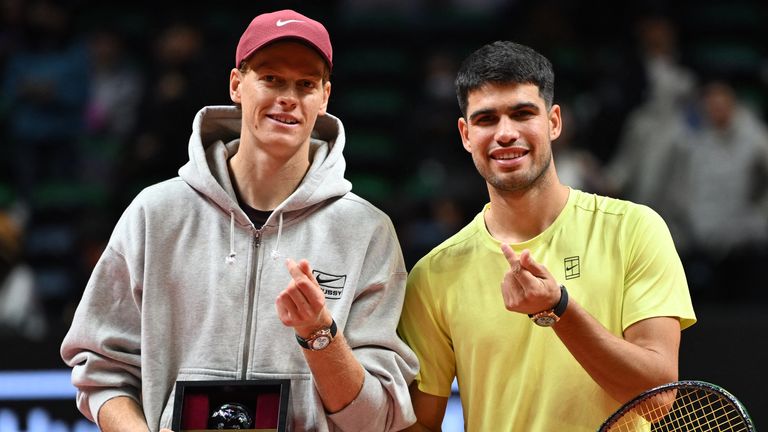
The Federer–Nadal rivalry produced 11 consecutive Grand Slams. Alcaraz and Sinner are at nine, and they are barely into their mid-twenties. Unlike the Big Three era — where Djokovic eventually came to dominate — this rivalry looks genuinely, structurally balanced. Which is rarer, and more exciting for tennis. It is the kind of sustained excellence that makes you appreciate why this sport has captivated fans for centuries.
More Than a Rivalry — A Gift to the Sport
After winning Roland Garros 2025, Alcaraz said it was a privilege to share the court with Sinner at every tournament, making history together. That sentiment — mutual respect forged through fierce, repeated competition — is what separates the great rivalries from the merely famous ones.
The Alcaraz–Sinner head-to-head stands at 11–8. Roland Garros 2026 will add to it. Whatever happens in Paris, the sport is in extraordinary hands.




No Comments